
 Made in our UK lab · Next Day Delivery

Varifocal vs Bifocal Glasses
This guide covers lenses, costs, adaptation and how to choose the right type for your lifestyle.
Published by Direct Sight | Eye Care Guide
What is the difference between varifocal and bifocal glasses and which should you choose??
If your optician has told you that you need multifocal lenses. Glasses that correct your vision at more than one distance. The next question is usually: varifocal or bifocal?
Both lens types correct distance and near vision in a single pair of glasses. However, the difference between them is significant. The right choice depends on your lifestyle, your prescription strength and what you are most comfortable with.
This guide explains how each lens type works, where they differ, the pros and cons of each, and, most importantly, which type is likely to suit you best.
This page covers the choice between varifocal and bifocal lenses.
How Bifocal Lenses Work
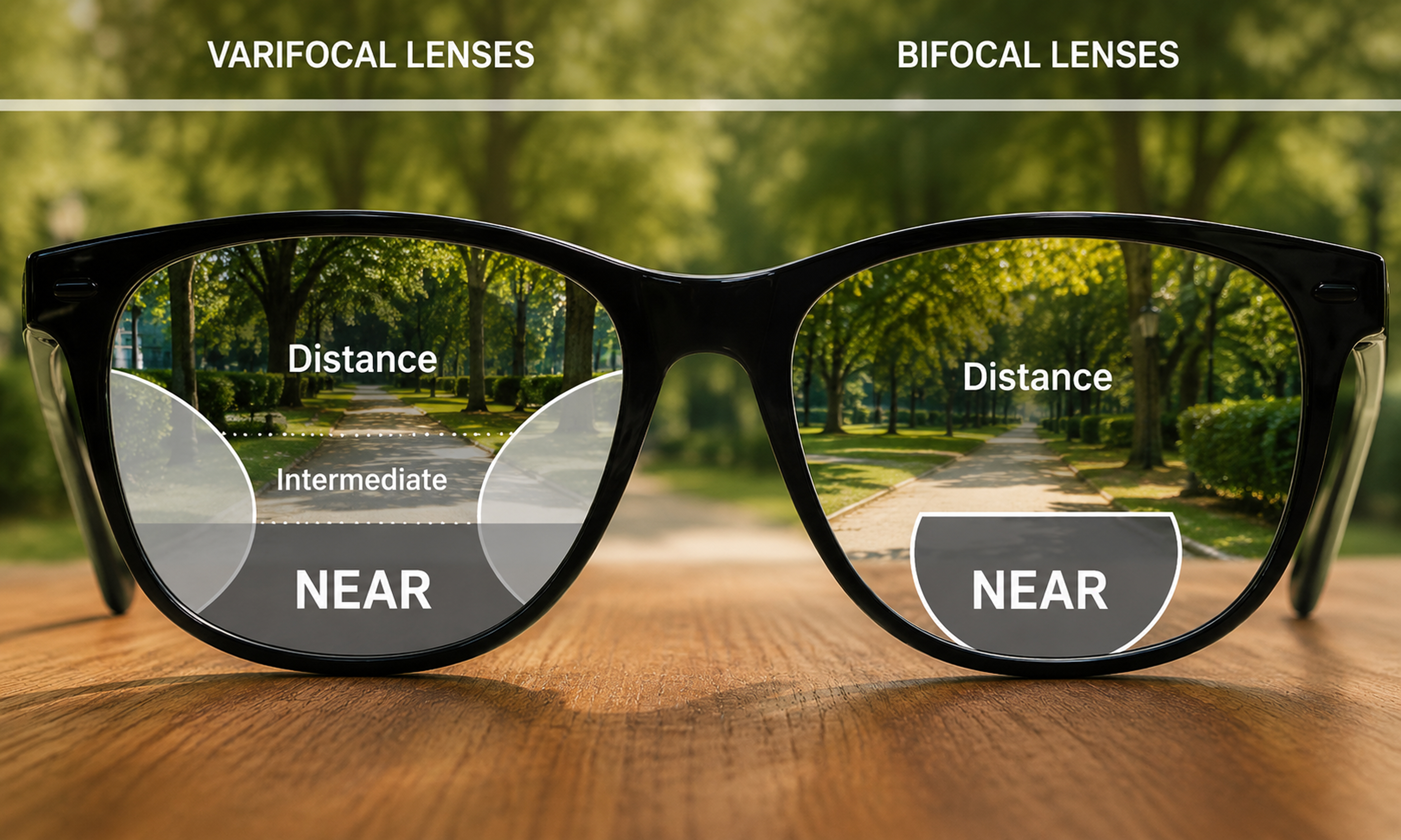
A bifocal lens has two distinct prescription zones, physically separated by a visible dividing line. The upper portion of the lens contains your distance prescription for driving, watching television or looking across a room. The lower portion contains your reading prescription for books, phones, menus and close-up tasks.
The line between the two zones is a real optical boundary, not simply a change in lens curvature. When you look through the main portion of the lens, you get distance. When your eyes drop below the line, can focus on nearby objects such as reading. There is no gradual transition between them.
Types of Bifocal Lens
The most common bifocal lens design in the UK is the flat-top or D-segment bifocal. Where the reading segment is a D-shaped area in the lower portion of the lens. The flat edge of the D is the visible line.
A less common variant is the round-segment bifocal. Where the reading area is a circular window within the lower lens. This is more visible but easier for some wearers to locate.
Executive or E-style bifocals, occasionally prescribed for occupational use. Where the line runs the full width of the lens.
At Direct Sight we only offer the D28 Bifocal Lens.
What Bifocal Lenses Do Not Provide
As Bifocal lenses have only two zones, they have no intermediate vision correction. They will not cover arms length distances such as, a computer screen, a car dashboard, a music stand, supermarket shelves. This gap in the middle is the fundamental limitation.
How Varifocal Lenses Work
Varifocal lenses, also called progressive lenses, solve the intermediate gap. A varifocal lens has a gradual change in prescription from top to bottom.
The top of the lens is your full distance prescription. The bottom is your reading prescription. The middle, the corridor running down the centre of the lens, provides an intermediate prescription between the two.
The prescription changes gradually rather than jumping between fixed zones and there is no visible line, for smooth focus at any distance. To an observer, a varifocal lens looks identical to a single vision lens.
The trade-off is that the prescription cannot be uniform across the full width of the lens. The sides of a varifocal lens, where the prescription transitions most sharply, are less clear than the central corridor. This peripheral distortion is the distinctive feature that new varifocal wearers often struggle to adapt to. It does not exist in bifocal lenses.
The Visible Line, does It Matter?
Some wearers find the visible line is not an issue. It is simply a practical feature of how the lens divides the distinct optical powers. After a few days of wear, they stop noticing it.
For others, particularly those who are conscious of the visible line or who associate the line with older age. Find varifocal lenses are cosmetically a better option.
Most bifocal wearers adapt quickly. But some find it distracting where the prescription changes abruptly rather than gradually. Particularly in dynamic environments such as driving or descending stairs.
The Intermediate Zone, the Biggest Practical Difference
Screens have changed the way most adults use their vision. A typical computer or laptop screen sits at a distance of 50 to 70cm. Too close for the distance zone of a bifocal and too far away for the reading zone. Reading from a mobile phone or tablet at arm's length may present the same challenge.
Bifocal wearers often find themselves tilting their head back to use the reading segment or leaning forward towards the screen. Often removing their glasses altogether when using a computer. None of these are comfortable over a full working day.
Varifocal wearers in the same situation simply look through the intermediate corridor of the lens at the screen. Then drop their eyes slightly to read printed documents. No head movement or removing the glasses required.
This practical difference matters less for wearers whose daily life does not involve significant screen use. If you spend most of your day reading books and rarely use a computer. The intermediate zone that varifocals provide may not justify the longer adaptation period that varifocal lenses often take.
For drivers, both lens types cover the distance zone. The dashboard sits at intermediate distance better served by varifocals. Though many experienced bifocal wearers manage this through small head movements.
Varifocal Bifocal Comparison UK
| Feature | Varifocal (Progressive) | Bifocal |
|---|---|---|
| Prescription Zones | Three: distance, intermediate, near | Two: distance and near only |
| Visible Line | ✕ Seamless, invisible transition | ✓ Visible D-segment line across lower lens |
| Adaption Period | 1 to 2 weeks typical; up to 3 for first-time wearers | Shorter, typically a few days |
| Peripheral Distortion | ✓ Soft edges at the sides of the lens | ✕ Optically clear across the full width of each zone |
| Cosmetic Appearance | Identical to single vision lenses | Visible line at close range |
| Jump between zones | None, smooth, gradual transition | Immediate jump as eye crosses the line |
|
Suitable for computer |
✓ Intermediate zone covers screen distances | Limited, no correction at 50 to 70cm |
| Suitable for driving | ✓ Full distance zone in upper lens | ✓ Full distance zone in upper lens |
| Cost at Direct Sight | Options from £45.00 | Options from £35.00 |
Varifocal Glasses, pros and Cons
Advantages of varifocal lenses
Disadvantages of varifocal glasses
Bifocal Glasses, pros and Cons
Advantages of bifocal glasses
Disadvantages of bifocal glasses
Who Should Choose Varifocal Glasses?
Varifocal glasses are the better choice for most people whose daily life involves a range of viewing distances. Particularly anyone who uses a screen regularly or drives alongside reading. They are a great option if you prefer to avoid the visible line of bifocals or want the convenience of one pair of glasses.
Varifocals are likely the better choice if you:
- Spend significant time at a computer, laptop or tablet each day
- Drive regularly, the intermediate zone covers dashboard distances that bifocals do not
- Want glasses that look like single vision lenses from the outside
- Have a prescription that includes significant astigmatism alongside your reading addition. Freeform varifocals handle complex prescriptions well across all zones
- Are ordering glasses for the first time and have no strong preference. Varifocals are now the default recommendation from most UK opticians to correct presbyopia
- Are active or outdoors frequently and need clear vision at multiple distances without thinking about which zone to use
Who Should Choose Bifocal Glasses?
Bifocal glasses are the better choice for wearers whose lifestyle naturally divides into two clear distances. Typically looking across a room and reading, without significant screen use or complex intermediate needs. They are also worth considering if a previous attempt at varifocals was unsuccessful.
Bifocals are likely the better choice if you:
- Have already tried varifocals and found the peripheral distortion or adaptation period too difficult
- Rarely use a computer or device screen, your daily vision is divided between distance and reading
- Have a strong preference for the simplicity of two clear zones rather than a graduated corridor
- Need glasses for a specific activity where two clear zones are more practical, eg. certain occupational tasks where distance and near are alternated in a regular pattern
- Want a wider choice of frames, bifocal lenses require less vertical depth and are compatible with more frame styles
Switching Between Varifocal and Bifocal Glasses
Switching from bifocals to varifocals
Moving from bifocals to varifocals requires a genuine adaptation period, typically one to two weeks of consistent daily wear. The key challenge is learning to use a graduated corridor rather than jumping between two fixed zones. Learning to ignore peripheral distortion that did not exist in your bifocal lenses.
Wearers who have worn bifocals for many years sometimes find this harder than first-time varifocal wearers. With varifocals, you move your head rather than your eyes to focus through the centre of the lens.
The most common mistake is expecting the reading zone to be where the bifocal reading segment was. In a varifocal, the reading zone is at the bottom of the central corridor. This is accessed by lowering the eyes further than bifocal wearers are used to. Our adjustment guide covers this in detail.
Other Lens Options Worth Knowing About
Office lenses (occupational progressives)
An office lens is a specialist lens designed for desk and screen use. This is sometimes called a near-variable focus or occupational progressive.
It covers near and intermediate distances (from reading distance up to approximately two metres). It has a wider, more comfortable near corridor than a standard varifocal.
Office lenses do not include a distance prescription and cannot be used for driving. They suit wearers who spend most of their working day at a desk. Direct Sight offers the Office Lens as one of its four varifocal options.
Separate pairs for distance and reading
For some wearers, particularly those with straightforward prescriptions opt for two separate single vision pairs. One for distance and one for reading.
Single vision lenses eliminate both the adaptation period and the peripheral distortion of varifocal lenses entirely. They are often a more cost effective option. The inconvenience of switching between two pairs is the only drawback.

Ready to shop for your glasses?
Browse our range of frames and customise with your choice of varifocal or bifocal lens options
Related Categories
Frequently Asked Questions
What is the main difference between varifocal and bifocal glasses?
Bifocal lenses have two zones: distance at the top and reading at the bottom, separated by a visible line.
Varifocal lenses have three zones - distance, intermediate and reading - with no visible line and a smooth, gradual change from top to bottom. The intermediate zone in varifocals covers screen distances, dashboards and arm's-length tasks that bifocal lenses don't address.
Are varifocal glasses better than bifocal glasses?
Neither is necessarily better the right choice depends on your lifestyle and prescription.
Varifocal glasses are better for wearers who use screens regularly, drive, or want invisible multifocal lenses. They provide correction at all distances and look identical to single vision lenses.
Bifocal glasses are better for wearers who only need two distances. Have previously struggled to adapt to varifocals, or want a more affordable option. Many long-term bifocal wearers are entirely satisfied with them and see no reason to switch.
Which is easier to adapt to, varifocal or bifocal glasses?
Bifocal glasses are generally easier to adapt to. The hard dividing line between the zones makes it immediately clear which part of the lens provides distance vision and which provides near vision. Adaption typically takes a few days.
Varifocal glasses require the wearer to find a graduated corridor and ignore peripheral distortion that bifocals do not have. For most varifocal wearers, adaptation takes one to two weeks of consistent daily wear.
Can I switch from bifocal to varifocal glasses?
Yes. Switching from bifocals to varifocals is straightforward. You simply order varifocal lenses to your current prescription (including the ADD value shown on your prescription).
The adaptation period is similar to switching varifocal brands, typically one to two weeks of consistent wear. The main adjustment is learning to use the graduated corridor rather than looking for the line. Learning to direct your nose rather than only your eyes towards what you want to look at.
Long-term bifocal wearers sometimes take slightly longer to adapt because the line-crossing habit is deeply established. Our adjusting to your varifocal glasses guide explains the process in full.
Can I switch from varifocal to bifocal glasses?
Yes. Switching from varifocals to bifocals is usually quick. Most varifocal wearers adapt to bifocals within a few days.
The peripheral distortion that varifocals require you to ignore disappears immediately. Each zone becomes optically clear to the edges.
The trade-off is the loss of the intermediate zone. If you were using your varifocals for screen work, you will notice that the screen distance is no longer comfortably covered. Some wearers find this more significant than expected. If you are switching because varifocal adaptation was unsuccessful after consistent wear, bifocals are a sound optical alternative.
Do bifocal glasses have a visible line?
Yes. The most common bifocal design in the UK, the D-segment or flat-top bifocal. Has a clearly visible horizontal line across the lower portion of the lens. This marks the boundary between the distance and reading zones.
The line is part of how the lens works: it marks the optical boundary where one prescription ends and the other begins. Some wearers find the line becomes invisible to them in daily use because they stop noticing it. Others remain aware of it. If the visible line would concern you, varifocal lenses are cosmetically invisible as multifocal lenses.
Are bifocal glasses cheaper than varifocal glasses?
Generally yes. Bifocal lenses are simpler to manufacture than varifocal lenses, which results in a lower price. At Direct Sight, bifocal lenses start from £35.00 and varifocal lenses from £45.
The difference can be significant, particularly for premium varifocals with the widest fields of clear vision.
Should I get varifocals or bifocal?
Choosing between varifocals and bifocals depends on your lifestyle, vision needs, and comfort preferences.
Varifocal lenses (also known as progressive lenses) provide a smooth transition between distance, intermediate, and near vision. This makes them ideal if you regularly switch between activities like driving, working on a computer, and reading. They offer a more natural viewing experience and a modern, clean look, which makes them a popular choice in the UK for everyday wear.
Bifocal lenses, on the other hand, have two distinct prescription zones. Typically distance at the top and reading at the bottom, separated by a visible line. They can be easier to adapt to and are often more affordable, which makes them a practical option if you mainly need help with reading while maintaining clear distance vision.
In general, choose varifocals if you want all-in-one convenience. A line-free appearance, and use multiple focal distances throughout the day. Opt for bifocals if you prefer a simpler lens design, quicker adjustment, and a more budget-friendly solution.
Still not sure? Contact us and a member of our experienced team will advise which option best suits your prescription.
What is the intermediate zone and why does it matter?
The intermediate zone is the part of a varifocal lens that provides correction for viewing between distance and near. Intermediate covers computer screens, laptops, tablets, car dashboards, music stands, shelves across a room, and most arm's-length tasks. Anything at roughly 40cm to 2 metres away.
Bifocal lenses do not have an intermediate zone. The distance prescription covers far vision and the reading prescription covers close-up work, with no correction in between.
For wearers who use screens regularly, the intermediate zone is the most significant difference between varifocal and bifocal lenses.
Can varifocal lenses correct astigmatism?
Yes. Both varifocal and bifocal lenses can be made to correct astigmatism alongside the presbyopia reading addition and distance prescription.
Your optician will include the cylinder (CYL) and axis values on your prescription if you require astigmatism correction.
A premium freeform varifocal design, such as Varifocal Advanced or Elite at Direct Sight, is often the best choice. They typically handle complex prescriptions more comfortably than entry-level options.
Can I wear varifocal or bifocal glasses for driving?
Yes. Both varifocal and bifocal glasses are suitable for driving.
The upper portion of both lens types contains your full distance prescription, which provides clear vision for road, hazard and sign awareness.
The dashboard sits at intermediate distance better covered by a varifocal's intermediate zone. Though experienced bifocal wearers typically manage this through small head movements.
If you are new to either lens type, allow a few days of non-driving wear before driving. This will allow you to become familiar to the peripheral distortion (varifocals) or line-crossing (bifocals).
The Direct Sight Office Lens is the one exception it has no distance zone and must not be used for driving.
What frame depth do I need for bifocal and varifocal lenses?
Varifocal lenses require a minimum lens height of 30mm. This to accommodate all three prescription zones of distance, intermediate and reading. With sufficient depth for each to be usable. Frames below this can be fitted with varifocal lenses, but the reading corridor will be compressed.
Bifocal lenses require a lens height of approximately 22 to 24mm. This is sufficient for the D-segment reading area to sit comfortably in the lower portion of the lens.
At Direct Sight, only frames with sufficient lens depth, will have the option to customised with varifocal or bifocal lenses.