
 Made in our UK lab · Next Day Delivery
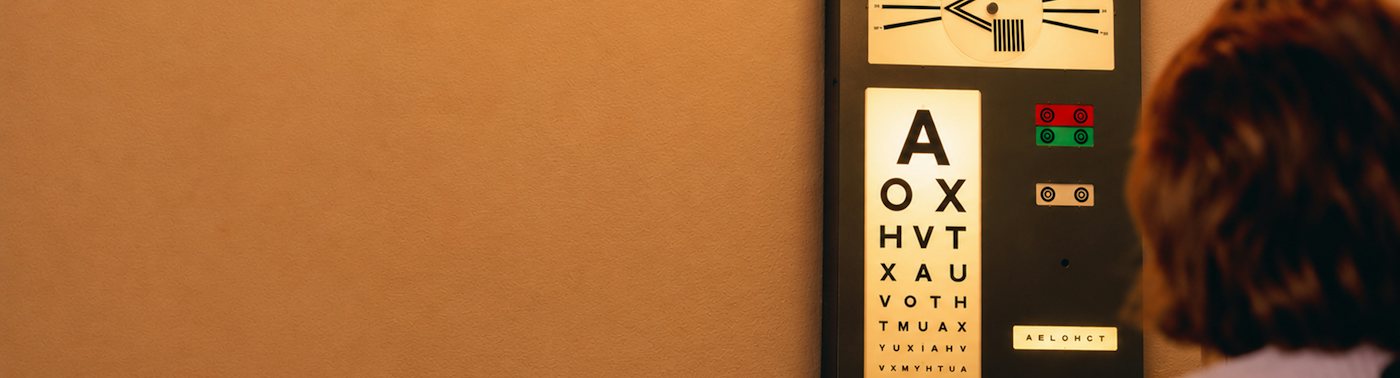
What Is Visual Acuity
What does your score actually mean?
Published by Direct Sight | Eye Care Guide
You've sat in that chair, covered one eye, and read letters off a chart more times than you can remember. But have you ever stopped to wonder what the numbers your optometrist writes down actually mean? Visual acuity is one of the most fundamental measures in eye care and understanding it properly can change how you think about your own vision.
What is Visual Acuity?
Visual acuity is the clinical term for the sharpness of your central vision. Specifically, your ability to resolve fine detail at a given distance. It tells you nothing about colour perception, contrast sensitivity, peripheral vision, or how well your eyes work together. What it does measure, very precisely, is whether the central part of your retina is receiving a clear enough image to distinguish small, closely spaced details.
The reason it matters so much is that central, detailed vision is what you rely on for almost everything you consciously look at. Reading, recognising faces, watching television, driving, working at a screen. A drop in visual acuity is usually the first thing people notice when their vision isn't as sharp as it once was.
How it's measured: the Snellen chart
Most people have seen a Snellen chart without knowing its name. It’s the eye test chart with rows of letters that get smaller on each line. Created by Dutch eye doctor Herman Snellen in 1862, it is still used by opticians worldwide today. Despite advances in eye testing technology, it remains one of the quickest and most reliable ways to measure vision.
The test itself is simple. You stand or sit six metres from the chart and read the letters, one eye at a time, until they become too small to see clearly. Your result is written as a fraction such as 6/6, 6/9, or 6/12.
The top number is always 6, which is the testing distance in metres. The bottom number shows the distance at which someone with standard vision could read the same line.
So, a result of 6/6 means you can see at six metres what a person with normal vision sees at six metres. A result of 6/12 means you can only see at six metres what someone with normal vision could see from twelve metres away, meaning your vision is less sharp. Some people can even achieve 6/5 or 6/4, which means their vision is sharper than average.
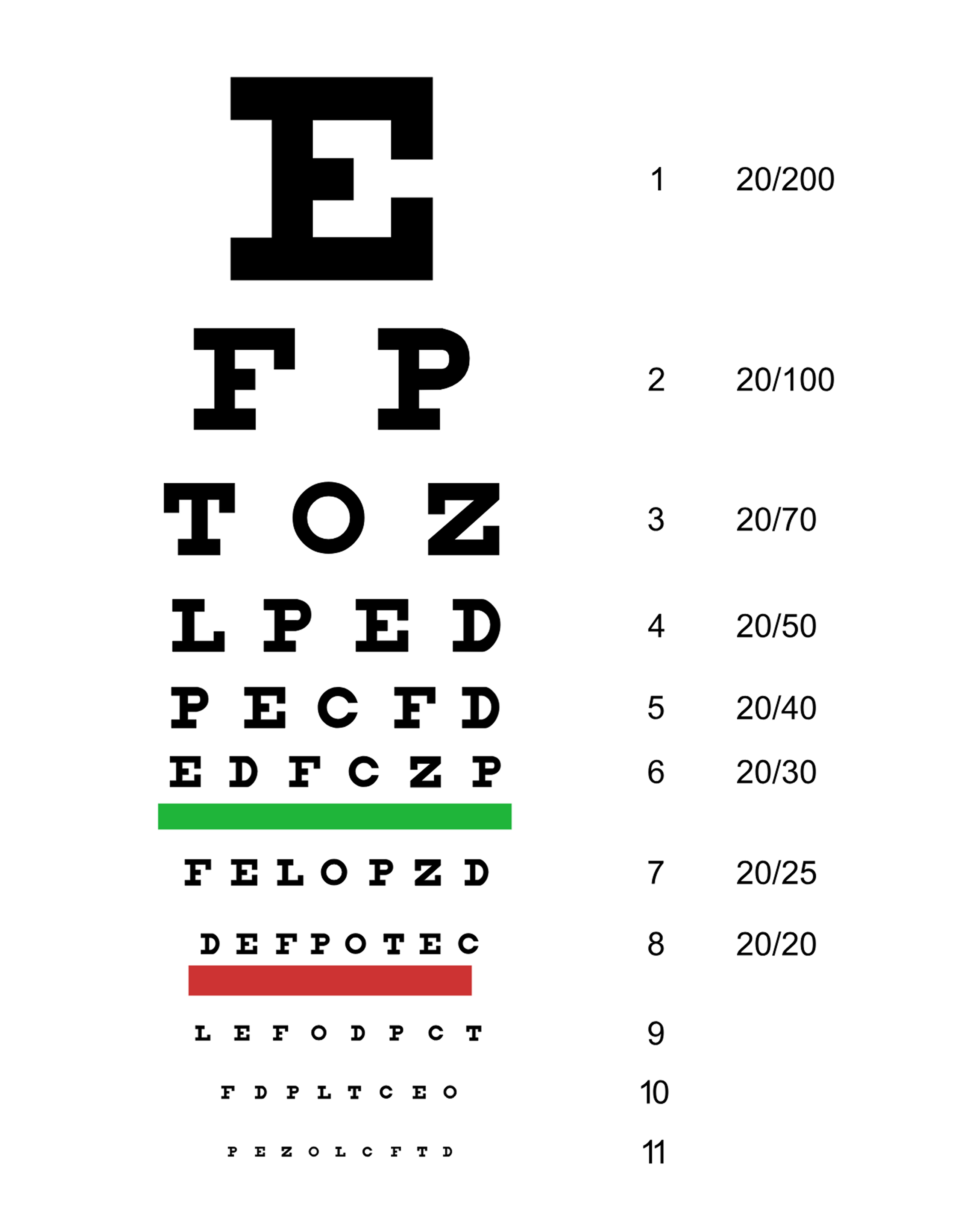
What common Snellen scores mean (UK)
6/4, exceptionally sharp vision, better than average
6/6, normal, clinically standard vision
6/9, mildly reduced; may or may not need correction
6/12, minimum legal standard for driving in the UK
6/18, moderate reduction; correction almost always recommended
6/60, the top letter on the chart; significant impairment
3/60 or worse, threshold for registration as severely sight impaired (blind) in the UK
What does 6/6 mean, and is it actually perfect?
6/6 is the clinical benchmark for normal or 20/20 vision. That doesn't mean it's the limit of what's possible or that every person with 6/6 has "perfect" eyesight. The 6/6 line was designed to represent what a typical, healthy eye can resolve. Plenty of young adults with excellent vision can read the 6/5 or 6/4 lines, they are seeing more detail than the benchmark requires.
6/6 visual acuity doesn't mean there's nothing to correct. Someone could score 6/6 through sheer effort. Their eye muscles working hard to accommodate a mild long-sighted prescription. But could still benefit from glasses to reduced headaches and eye strain.
Visual acuity is one piece of data, it doesn't replace the full story that comes from a comprehensive eye examination.
Visual acuity and your glasses prescription
Your visual acuity score is not the same as your glasses prescription, though the two are clearly related. The prescription including the SPH, CYL and Axis values describes the optical correction needed to give your eye the best possible acuity. Your score on the chart tells your optometrist how well that correction is working, or how much your uncorrected vision deviates from the norm. If you've ever wondered what the numbers on your prescription actually mean, our guide to understanding your glasses prescription walks through exactly that.
The optometrist will measure your uncorrected acuity first, without glasses or contact lenses. Then your best-corrected acuity, which is the sharpest you can see with the optimal prescription in place.
A large difference between the two figures suggests there's meaningful correction to be gained from glasses. A small difference suggests your uncorrected vision is reasonably close to what lenses could achieve.
Visual acuity in the UK: the numbers that matter in daily life
While 6/6 is the clinical benchmark, two other points on the Snellen scale have very concrete real-world implications in the UK:
| Visual Acuity | What it means | Key information |
|---|---|---|
| 6/12 | Minimum legal standard for driving in the UK | Under DVLA regulations, drivers must achieve at least 6/12 vision (0.5 decimal) using both eyes together, with glasses or contact lenses if needed. This is roughly equivalent to being able to read a standard number plate from 20 metres away. Falling below this standard means you must stop driving and inform the DVLA |
| 6/7.5 (better eye) 6/60 (other eye) |
Minimum standard for Group 2 licences | Drivers of heavy goods vehicles (HGVs) and buses must meet a stricter eyesight requirement of at least 6/7.5 in the better eye and 6/60 in the other eye. |
| 3/60 | Threshold for severe sight impairment registration | Vision of 3/60 or worse in both eyes, even with the best possible correction, may qualify someone as severely sight impaired (legally blind) in the UK. Visual field loss is also considered alongside visual acuity. Registration can provide access to support services and benefits. |
What affects visual acuity?
Many things can reduce visual acuity, some temporary, some progressive, some correctable and some not:
- Refractive Errors - Short-sightedness, long-sightedness, astigmatism and presbyopia are the most common causes of blurred vision.
- Cataracts - Clouding of the eye’s lens reduces vision over time.
- Macular Conditions - Diseases affecting the central retina, such as AMD, reduce detailed central vision.
- Glaucoma - Primarily damages peripheral vision, but can affect central vision in later stages.
- Amblyopia (Lazy eye) - Reduced vision in one eye caused by abnormal visual development in childhood.

Ready to order glasses online?
Browse our full range of frames and customise your lenses
Related Categories
Frequently Asked Questions
Is 6/6 vision the same as perfect vision?
Not exactly. 6/6 is the clinical benchmark for normal vision. What a statistically average, healthy eye should be able to resolve from six metres. Some people can see better than this, achieving 6/5 or 6/4 on the chart.
Having 6/6 also doesn't mean there's no correction to be made. Someone straining to see 6/6 through an uncorrected long-sighted prescription may still benefit significantly from glasses in terms of comfort and reduced eye strain.
What is the minimum visual acuity needed to drive in the UK?
For standard (Group 1) car and motorcycle licences, the DVLA requires a minimum visual acuity of 6/12 on the Snellen scale. Measured using both eyes together, with glasses or contact lenses if worn.
You must also be able to read a number plate from 20 metres. For Group 2 licences (lorries and buses), the standard is stricter: at least 6/7.5 in the better eye and 6/60 in the other. If your vision falls below the required standard, you are legally required to notify the DVLA and stop driving. More detail is available at GOV.UK, driving Eyesight Rules.
Can visual acuity be improved without glasses?
In most cases where reduced visual acuity is caused by a refractive error, short-sightedness, long-sightedness, or astigmatism. Glasses or contact lenses are the standard first-line solution. Laser eye surgery can permanently reshape the cornea to correct refractive errors and may eliminate the need for glasses entirely in eligible candidates. There is no evidence that eye exercises, supplements, or other non-clinical interventions can reliably improve refractive-error-related acuity.
My child has been told they have reduced visual acuity in one eye. What does that mean?
Reduced visual acuity in one eye that persists even with the correct glasses prescription is most likely amblyopia, commonly called a lazy eye. This develops when the visual system does not receive a clear, balanced image from both eyes during early childhood. This causes the brain to gradually rely more heavily on the stronger eye.
The earlier it is identified and treated the better the outcomes. Treatments include glasses to correct any underlying refractive imbalanceand sometimes with patching. Children under 16 are entitled to free NHS sight tests; annual testing is recommended.
What does it mean if my visual acuity is different in each eye?
A difference in visual acuity between the two eyes is very common and can simply reflect that one eye has a stronger prescription than the other. When corrected with appropriate lenses, both eyes often achieve similar acuity. A persistent gap even with full correction may point to amblyopia, or to a condition specifically affecting one eye, such as early cataract, a retinal issue, or asymmetric glaucoma. An optometrist will investigate further if the difference is clinically significant.
How does visual acuity relate to the numbers on my glasses prescription?
They are related but not the same thing. Your glasses prescription describes the optical correction. The power of lens needed to give your eye the best possible image. Your visual acuity score tells the optometrist how clearly you are currently seeing, both with and without glasses.
A higher prescription doesn't automatically mean worse acuity if glasses are worn. The goal of a prescription is precisely to bring your corrected acuity as close to 6/6 as possible. If you'd like to understand what each value on your prescription means, our guide to understanding your glasses prescription explains it clearly.
Can I check my visual acuity at home?
There are online Snellen-style charts that can give a rough indication, but they come with significant limitations. Screen resolution, viewing distance and room lighting all affect accuracy, and most online tools cannot be calibrated reliably.
More fundamentally, a home acuity check cannot assess the health of your eyes. An optometrist's examination includes checks for glaucoma, retinal changes, cataract and other conditions that may be progressing without affecting your acuity score at all. A proper eye test every two years remains the only reliable way to monitor your eye health comprehensively.
References
NHS, eye Tests (When and Why to Have Them)
NHS, vision Tests for Children
College of Optometrists, what Happens During an Eye Examination
Royal College of Ophthalmologists, patient Information
RNIB, the Criteria for Sight Impairment Certification (UK)
GOV.UK, driving Eyesight Rules (DVLA)
GOV.UK, visual Disorders: Assessing Fitness to Drive
NCBI Bookshelf, evaluation of Visual Acuity (StatPearls, updated 2024)
PMC / NCBI, how to Measure Distance Visual Acuity (Community Eye Health Journal)
MedlinePlus, visual Acuity Test (National Library of Medicine)