
 Made in our UK lab · Next Day Delivery
How to Read Your Glasses Prescription
Everything you need to know about reading, understanding, and using your glasses prescription when ordering eyewear online.
Published by Direct Sight | Buying Guide

Glasses Prescription Explained UK
If you are confident to enter the prescription details yourself you can by selecting the enter now at checkout. We have put together the following video that should hopefully help you understand your prescription.
Glasses Prescription Explained UK
Your glasses prescription is a set of measurements from your optometrist that tells our laboratory technicians exactly how to make lenses to correct your vision. To most people it looks like a confusing row of numbers, abbreviations and + and − signs.
This guide will help you in understanding glasses prescriptions. So you can read your prescription confidently. Understand what each value means for your vision, and enter the details correctly when ordering glasses online.
Whether your prescription is simple (just a sphere value for each eye) or complex (including cylinder, axis, prism and a reading addition). This guide covers every abbreviation you are likely to see.
If you have a prescription from the NHS, Boots, Vision Express, Specsavers or any other optician in the UK. The terms below will appear in some form on your prescription.
Your Right to Your Prescription
By law in the UK, your optometrist is required to give you a copy of your prescription, without any obligation to buy glasses from them. This is set out by the General Optical Council (GOC). You are entitled to take your prescription to any optical retailer to buy your glasses.
If you did not receive your prescription, or if you have lost it, contact the practice where you had your eye test and ask for a copy. They are required to keep records and should be able to provide one.
Every Prescription Term Explained
What does SPH CYL and AXIS mean?
Sphere (SPH): The sphere on your prescription represents the lens strength required for clear vision. A minus (-) sign indicates nearsightedness (short-sighted), while a plus (+) sign indicates farsightedness (long-sighted). If the SPH column shows 0.00, Plano, PL or an infinity symbol (∞), it means you have no spherical correction in that eye.
Tip: A quick way to remember: minus = short-sighted (distance blurry); plus = long-sighted (near blurry).
Cylinder (CYL): The cylinder value reflects the lens power needed to correct astigmatism. If this section is blank, it means you do not have astigmatism.
Axis: If you have astigmatism, the axis number indicates the specific angle at which the lens should not have cylinder power, so your astigmatism is corrected properly. This will be a number between 1-180.
Tip: Enter the AXIS exactly as written on your prescription. Do not round it. Entering 12 when the prescription states 125 would result in incorrectly made lenses.
Addition (ADD): ADD (sometimes written as Near Add, NV Add or Reading Addition) is the extra magnification power added to the distance prescription to help with close-up tasks such as reading, computer use or close-up work.
Pupillary Distance (PD): PD is the distance in millimetres between the centres of your pupils. If your prescription does not include a PD, you can measure it at home using our step-by-step PD guide. It takes less than two minutes with a ruler and a mirror.
What a Glasses Prescription Looks Like
A typical UK glasses prescription is laid out as a table with two rows, one for each eye, and several columns. The right eye is always listed first and is labelled R, RE or OD (oculus dexter, Latin for right eye). The left eye is listed second and is labelled L, LE or OS (oculus sinister, Latin for left eye).
Common Optical Prescriptions
While all UK opticians follow the same clinical standards, the layout of prescription can vary. NHS prescriptions, Boots opticians, Vision Express, Specsavers and independent opticians may each present the same information in a slightly different format. Below are some examples of common optical prescriptions from several well-known high street opticians. For each example we have shown how the details would look when entered on our website.
Other Terms and Symbols You May See
Here are several examples of more unusual values you may find and what to do if they apply to you.
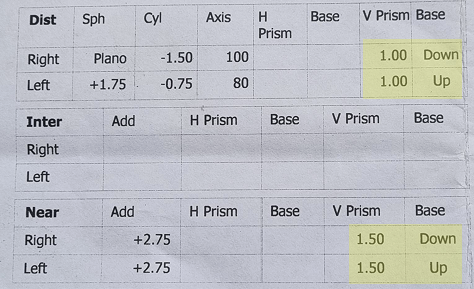
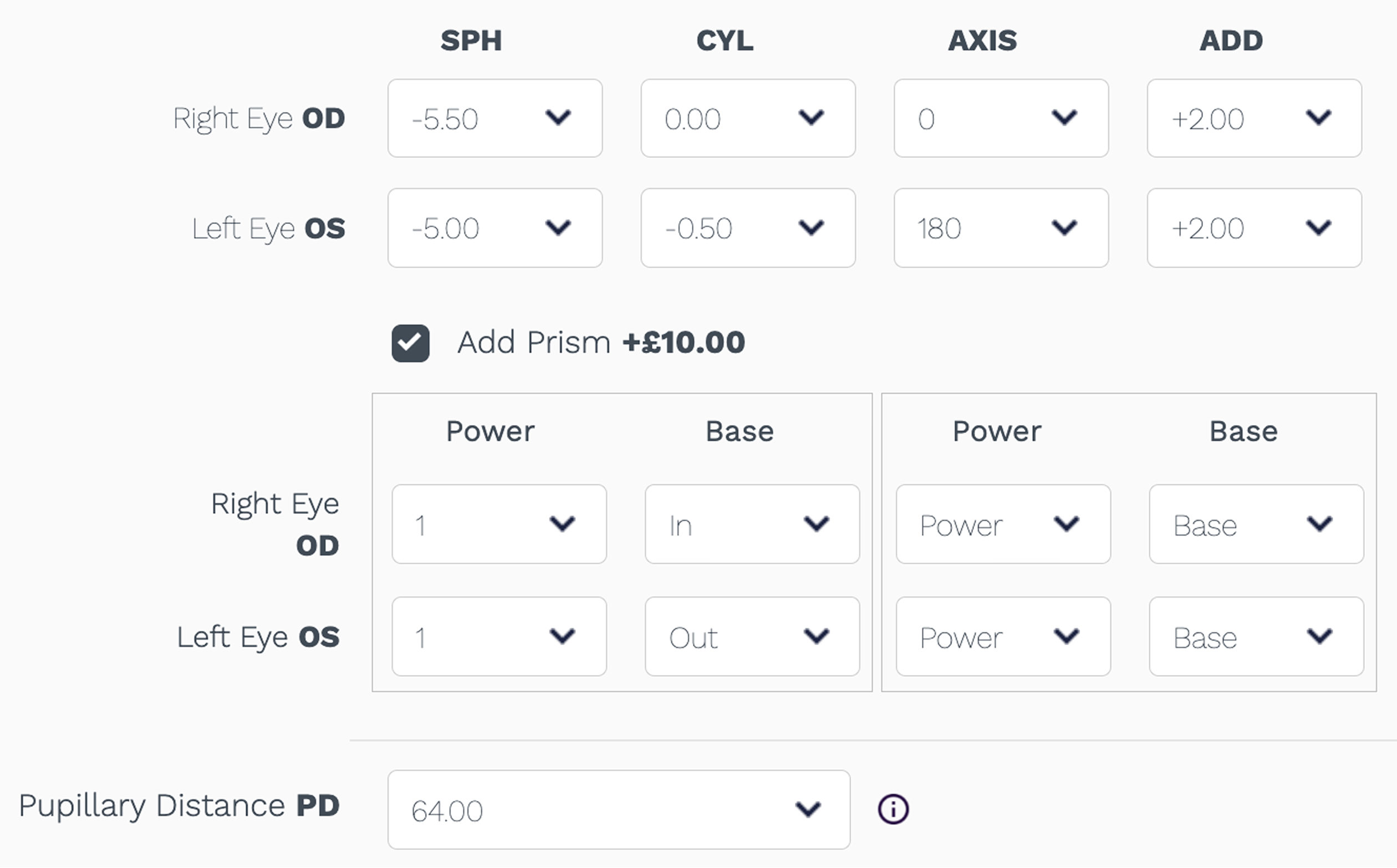
Prism and Base: If you have a prism value listed for one or both of your eyes then a number (Power) and direction (Base: Up, Down, In or Out) will be provided.
We can provide lenses with a prism correction between the Powers of 0.25-3.00. There is an additional charge for lenses to be made with a prism.
DS (Dioptre Sphere): The prescription below has DS written under the CYL column. DS (Dioptre Sphere) means there is no astigmatism or no value present, you can leave the field blank. There is also +2.50 written once in the Add field. This is the addition value for both eyes, although written once this would need to be entered for both eyes.

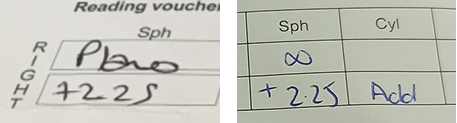
Plano / PL / ∞ (infinity symbol): means 0.00, no spherical correction needed in that eye. You may still have an astigmatism correction (CYL and AXIS values). You can either select 0 from the drop down or leave the field blank.
BAL (Balance): is sometimes written in one eye's column to indicate that the lens for that eye is a balance lens (non-prescriptive). This is used when one eye has very poor vision and will not benefit from optical correction.
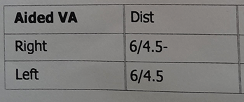
Sometimes you will be provided with Aided VA or BVD values. These are not needed to make your lenses.
Important Details To Check!
Check the power
The Sphere and Cylinder values could have either a + or - symbol in front of them. It is important that you select the number with the correct symbol eg +1.00 is not the same as -1.00.
Check for decimal
The Axis value may be a whole number eg 55 or a decimal of half eg 5.5 it is important you select the correct number.
Check the add
It is important to provide the correct Add value for your intended use, the Inter Add for computer glasses and the Near Add for reading glasses.
What Your Prescription Tells You About Your Vision
As well as telling us how to make your lenses, your prescription reveals something about how your eyes work:
Short-sightedness (Myopia): A minus (−) SPH value means you are short-sighted. You can see things close to you clearly, but objects at a distance appear blurry. Short-sightedness is the most common refractive error in the UK and typically develops in childhood or teenage years. It usually stabilises in adulthood, though prescriptions can continue to change.
Long-sightedness (Hyperopia): A plus (+) SPH value means you are long-sighted. Younger people can often compensate for long-sightedness using the focusing muscles of the eye. Meaning they may not notice blurry vision at typical distances until they are older. As the eye's ability to compensate reduces with age, symptoms become more apparent, particularly for near tasks.
Astigmatism: A CYL value on your prescription means you have astigmatism. A common condition where the cornea (the clear front surface of the eye) is slightly oval rather than perfectly spherical.
This causes light to focus at multiple points rather than one. This can result in blurred or distorted vision, ghosting around letters or objects, and difficulty seeing fine detail. Astigmatism can occur alongside short-sightedness, long-sightedness, or on its own.
Presbyopia and Reading Addition: From around the age of 40, the natural lens inside the eye gradually loses its ability to change shape and focus at different distances. This is called presbyopia and it is a normal part of ageing.
If you have an ADD value on your prescription, it means you have presbyopia and require additional correction for reading or close-up tasks.
Practical options are varifocal lenses, bifocal lenses, or a separate pair of glasses for reading glasses.
How to Enter Your Prescription When Ordering
When you reach the add glasses prescription step during checkout at Direct Sight, you have three options:
- Upload your prescription, photograph or scan your prescription slip and upload it. Our team will check every value before making your lenses. This is the method we recommend, as it eliminates the risk of manual entry errors.
- Enter the values manually, type each value from your prescription into the corresponding field. Take care with the + and − signs, decimal points and the AXIS value. If you are unsure about any value, upload rather than enter manually.
- Send it later, complete your order and email your prescription to help@directsight.co.uk before we begin making your lenses.
Prescription Strength and Lens Thickness
0.00 to ±1.50
Standard 1.5 index lenses are fine for most frames at this strength.
±1.75 to ±3.50
Standard lenses remain suitable. Higher index is available if you prefer a slimmer profile.
±3.75 to ±5.00
High index lenses (1.6 or 1.67) are recommended to keep lens edges reasonably thin.
Above ±5.00
High index lenses (1.67) are strongly recommended. Frame choice also matters.

Prescription details explained.
Providing the correct prescription details is crucial when ordering glasses from Direct Sight, as it ensures you receive lenses that perfectly match your vision needs. Accurate prescription information guarantees that your glasses provide optimal clarity and comfort, preventing issues like eye strain, headaches, or blurred vision.
At Direct Sight, we make it easy to provide your prescription details by offering the options of sending your prescription details after you have placed the order or attaching a copy of the prescription to your order. Our experienced team can then input your prescription, to double-check the details, such as sphere, cylinder, and pupillary distance, to ensure your lenses are tailored to correct your eyesight precisely, allowing you to confidently order glasses online.
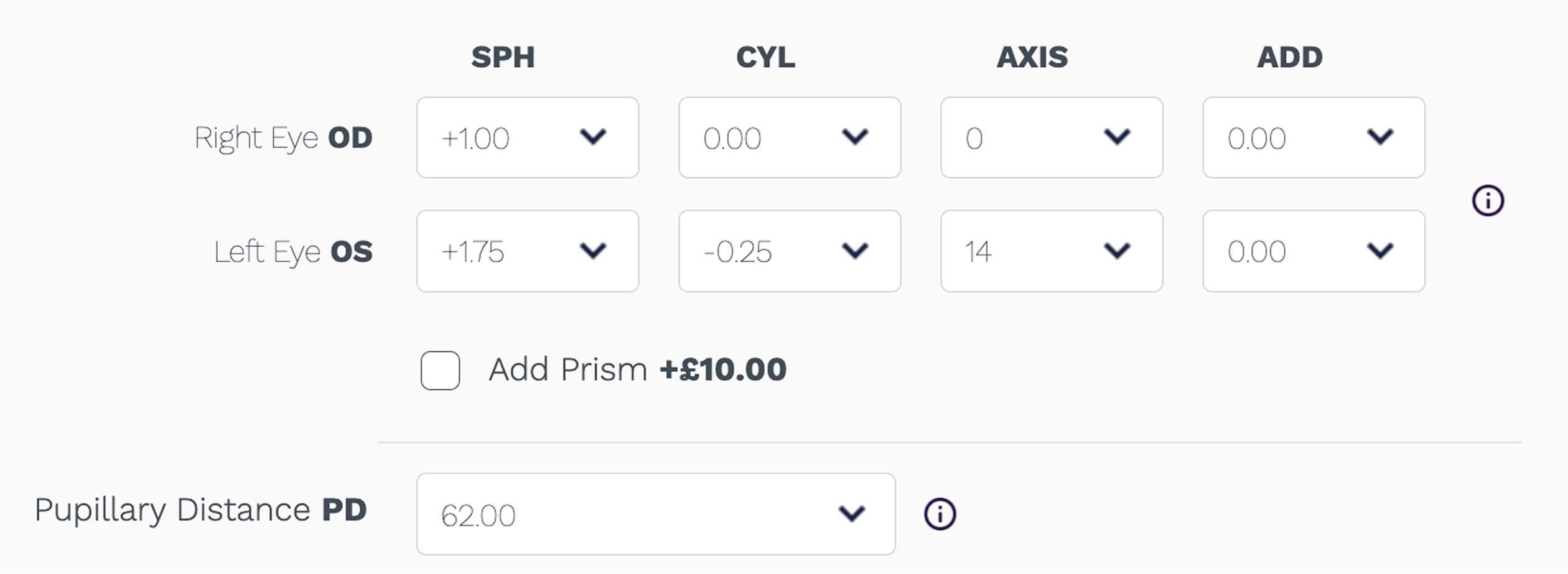
Farsighted prescriptions
A prescription for someone who is farsighted will have a number in the Sphere (SPH) box with a plus (+) symbol. This indicates that your lenses will be made to correct near vision.
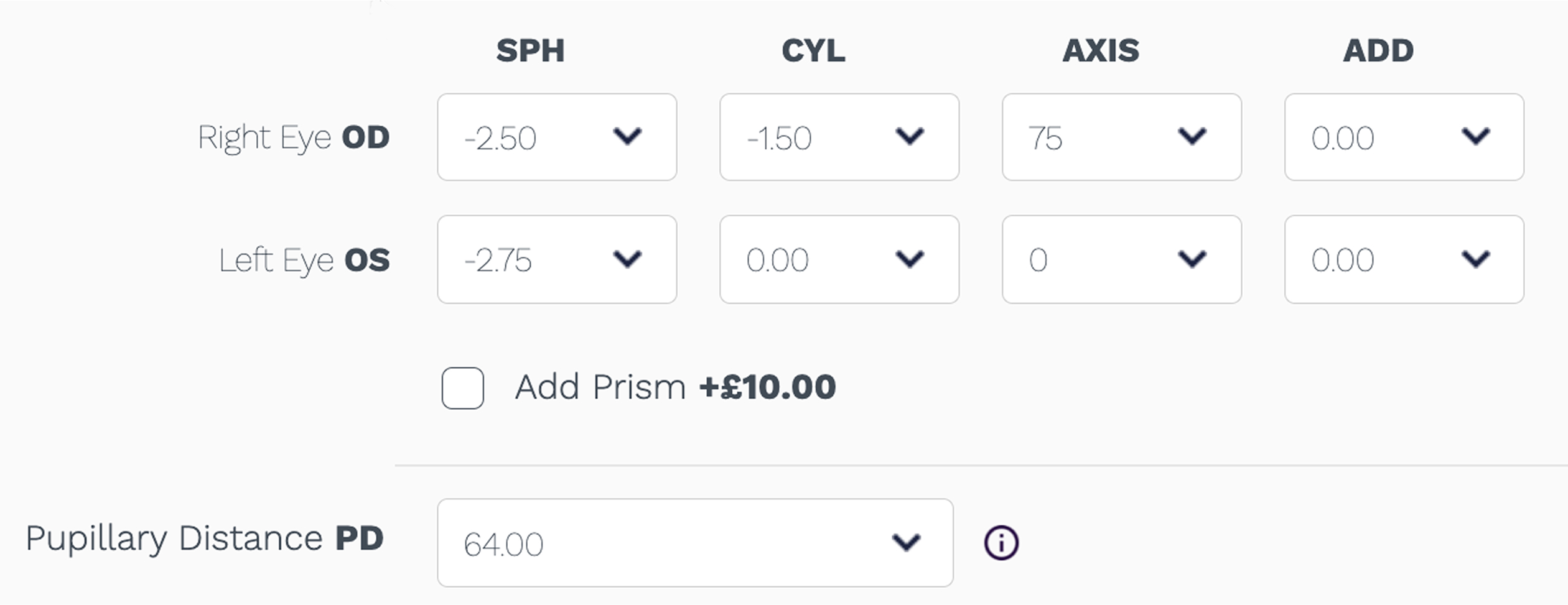
Nearsighted prescriptions
A prescription for someone who is nearsighted will have a number in the Sphere (SPH) box with a minus (-) symbol. This indicates that your lenses will be made to correct your distance vision.
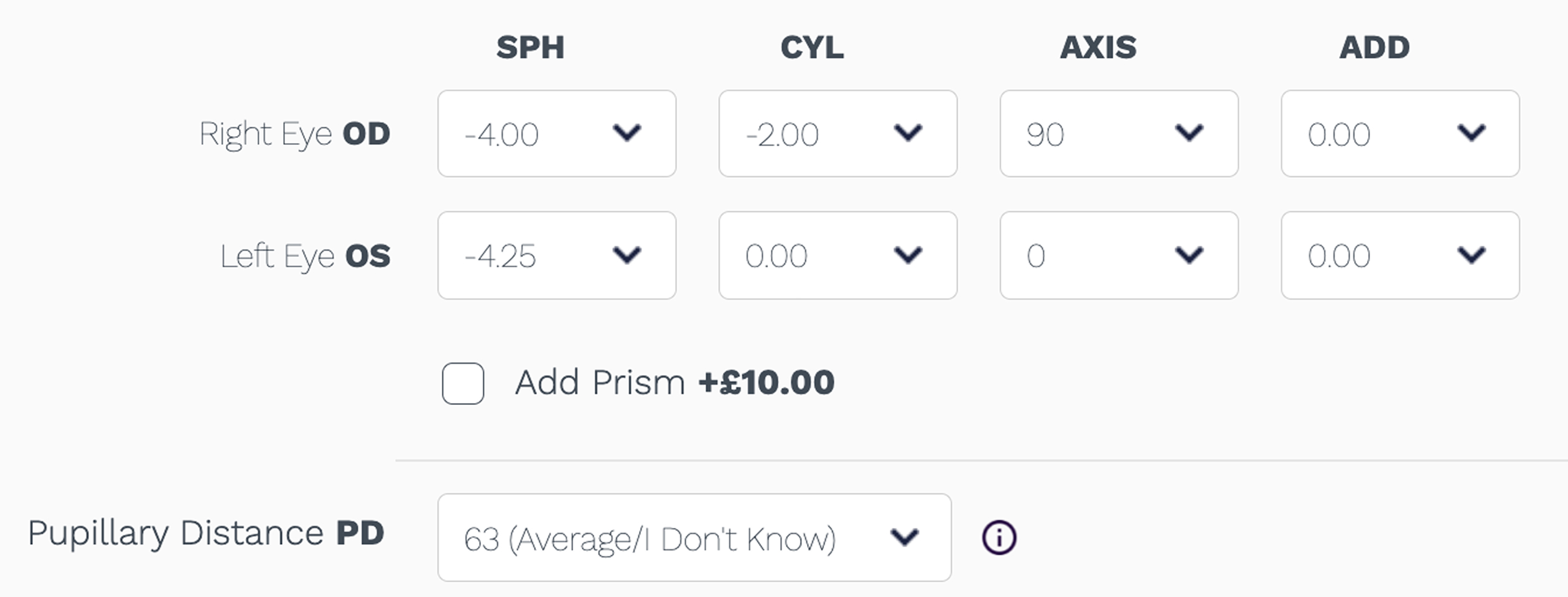
Astigmatism prescriptions
If you have astigmatism, your prescription will include a number in the ‘cylinder’ column that specifies the lens power required to correct it. Additionally, there will be a number in the ‘axis’ column that indicates the orientation needed for the correction.
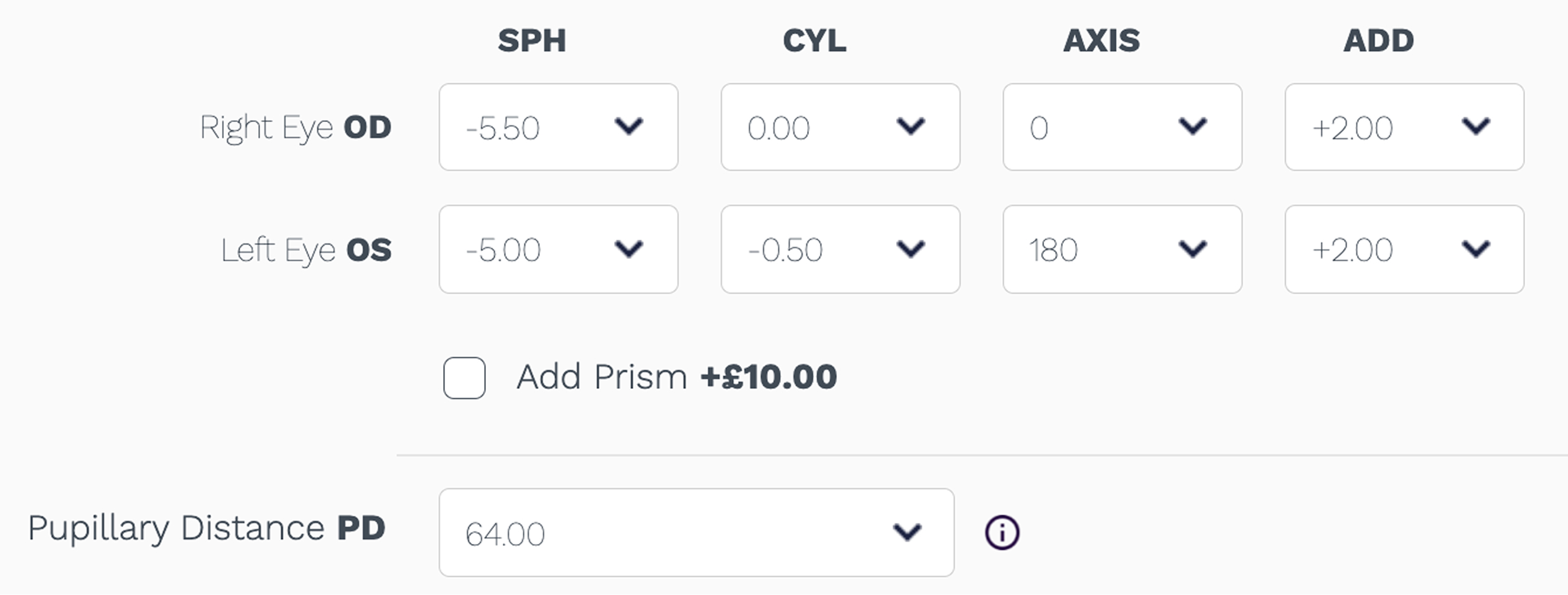
Bifocal, Varifocal (multifocal) & Reading prescriptions
A multifocal prescription and prescription for reading glasses will include an ADD value, occasionally marked as NV. The prescription will include details for your distance correction as well as your reading correction in your lens.
Prescriptions with prism correction
Your prescription will include a Prism and Base value if you have eye alignment issues. The base value will show either ‘in’ or ‘out’, or ‘up’ and ‘down’, indicating the direction the prism should be angled in the lens. These values tell us how to shape the lens to accurately align your eyesight. There is an additional charge for a prism to be added to your lenses.
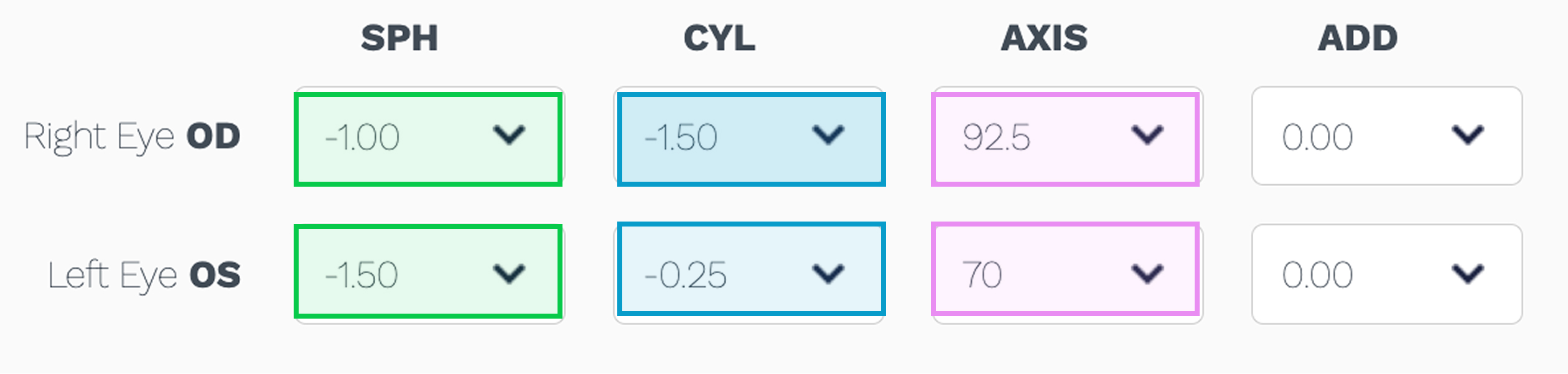
Standard NHS Prescription
The prescription below shows distance values at the top and near values at the bottom.

How it should look on our website for Distance glasses:
How it should look on our website for Reading glasses:
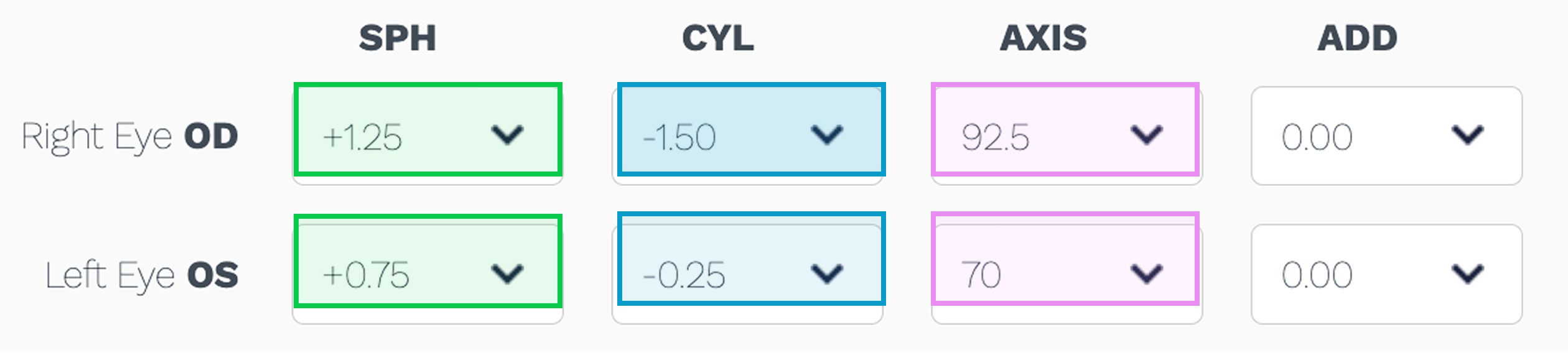
If you Varifocal or Bifocal lenses were required then the top line would need to be provided for the SPH, CYL and AXIS, the difference between the Distance and Near SPH values would be needed for the ADD. To ensure the correct details were applied we would recommend contacting our customer service team before trying to input these details or use our send later or upload options.
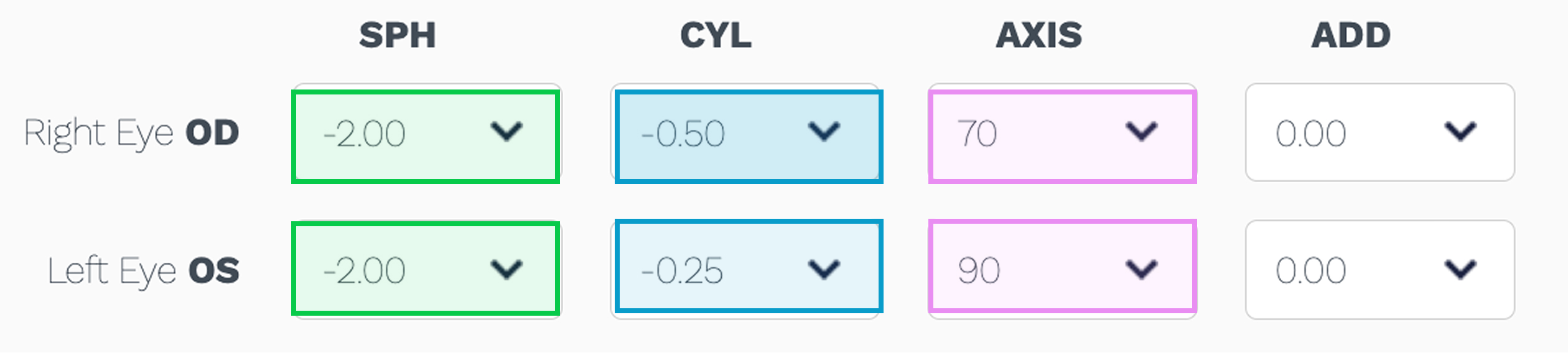
NHS Scotland Prescription
The prescription below shows distance values at the top and near values at the bottom.

How it should look on our website for Distance glasses:
How it should look on our website for Reading glasses:
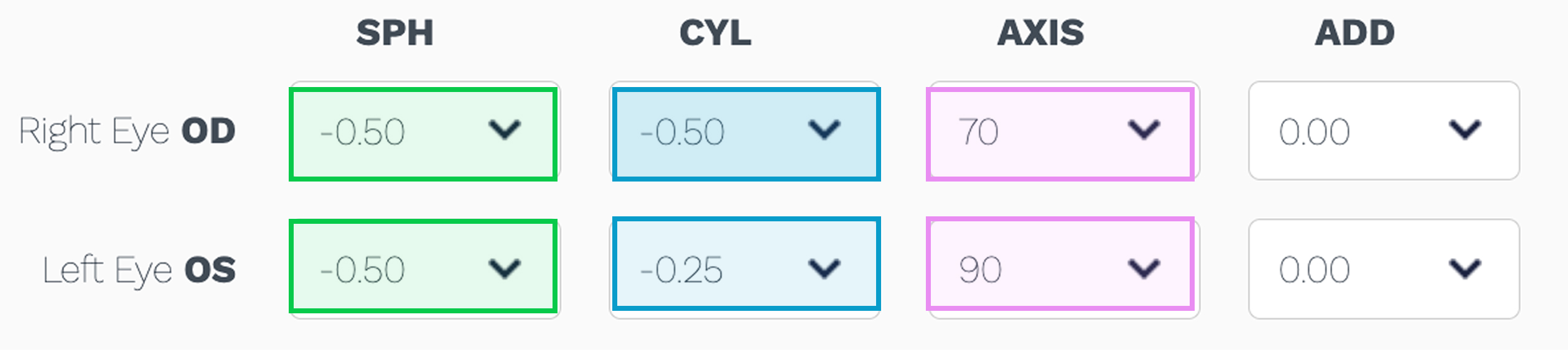
If you Varifocal or Bifocal lenses were required then the top line would need to be provided for the SPH, CYL and AXIS, the difference between the Distance and Near SPH values would be needed for the ADD. To ensure the correct details were applied we would recommend contacting our customer service team before trying to input these details or use our send later or upload options.
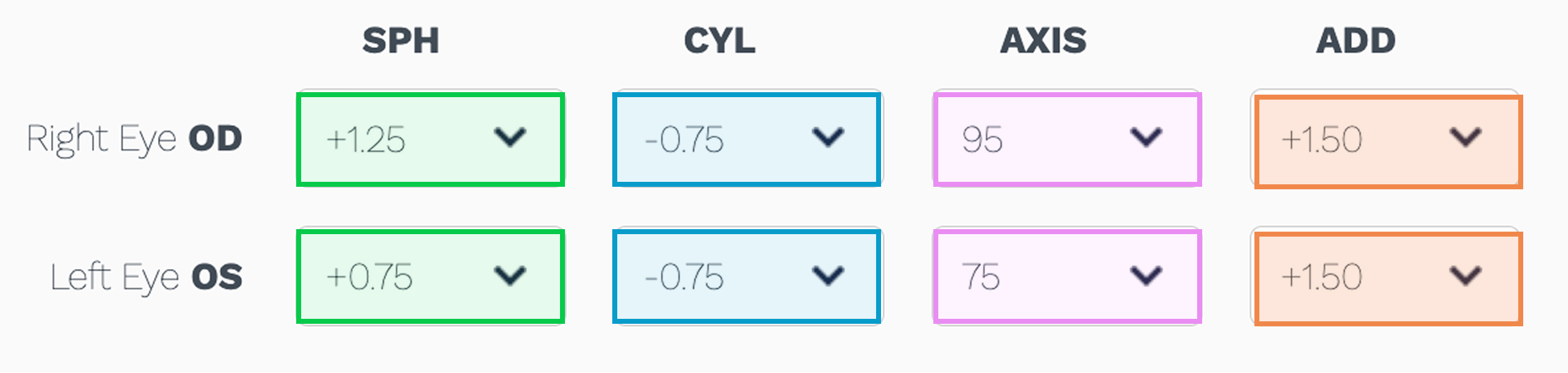
Specsavers Prescription
This prescription shows two different ADD values, the Near Add for Reading and the Inter Add for Computer.
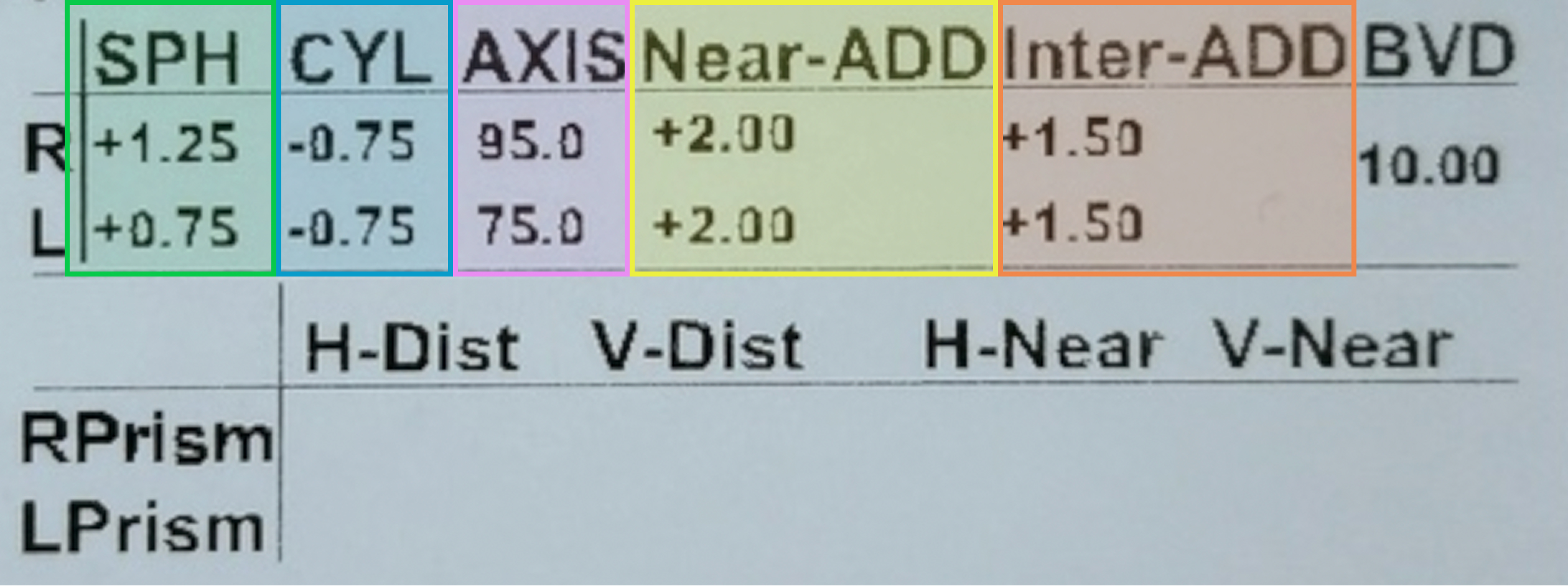
How it should look on our website for Reading glasses:
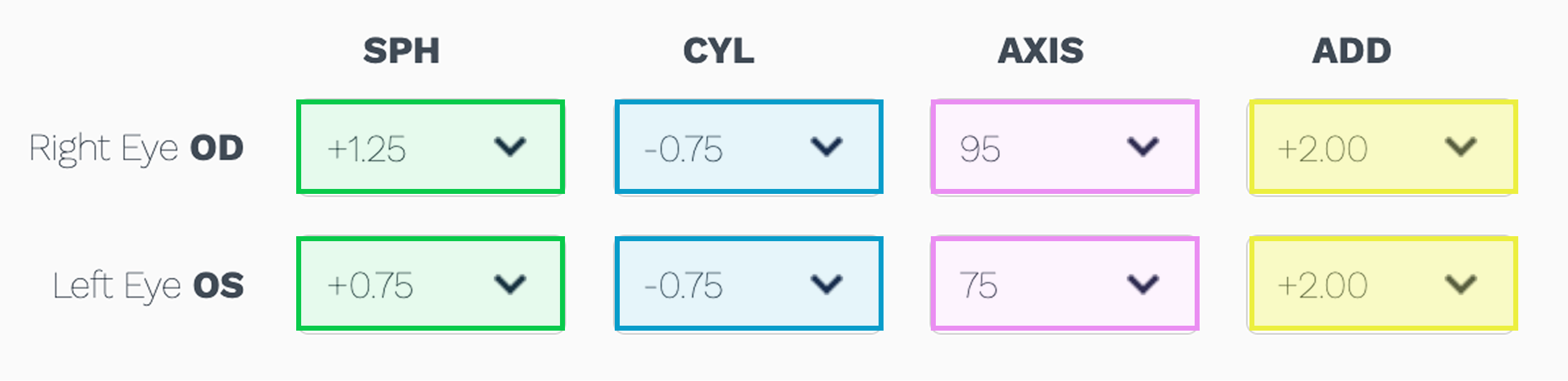
How it should look on our website for Computer glasses:
Vision Express Prescription
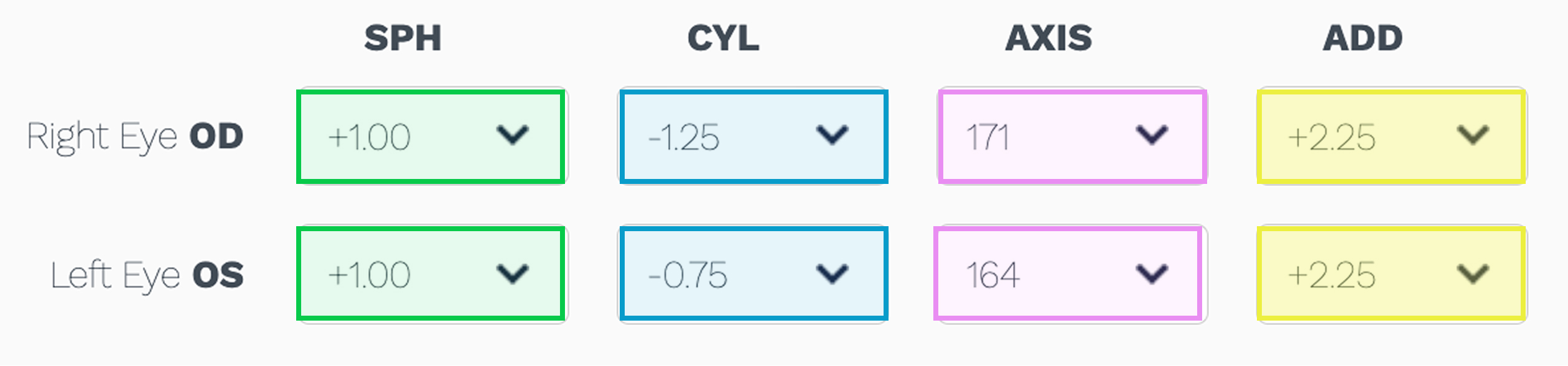
This prescription shows two different ADD values, the Near Add for Reading and the Inter Add for Computer.
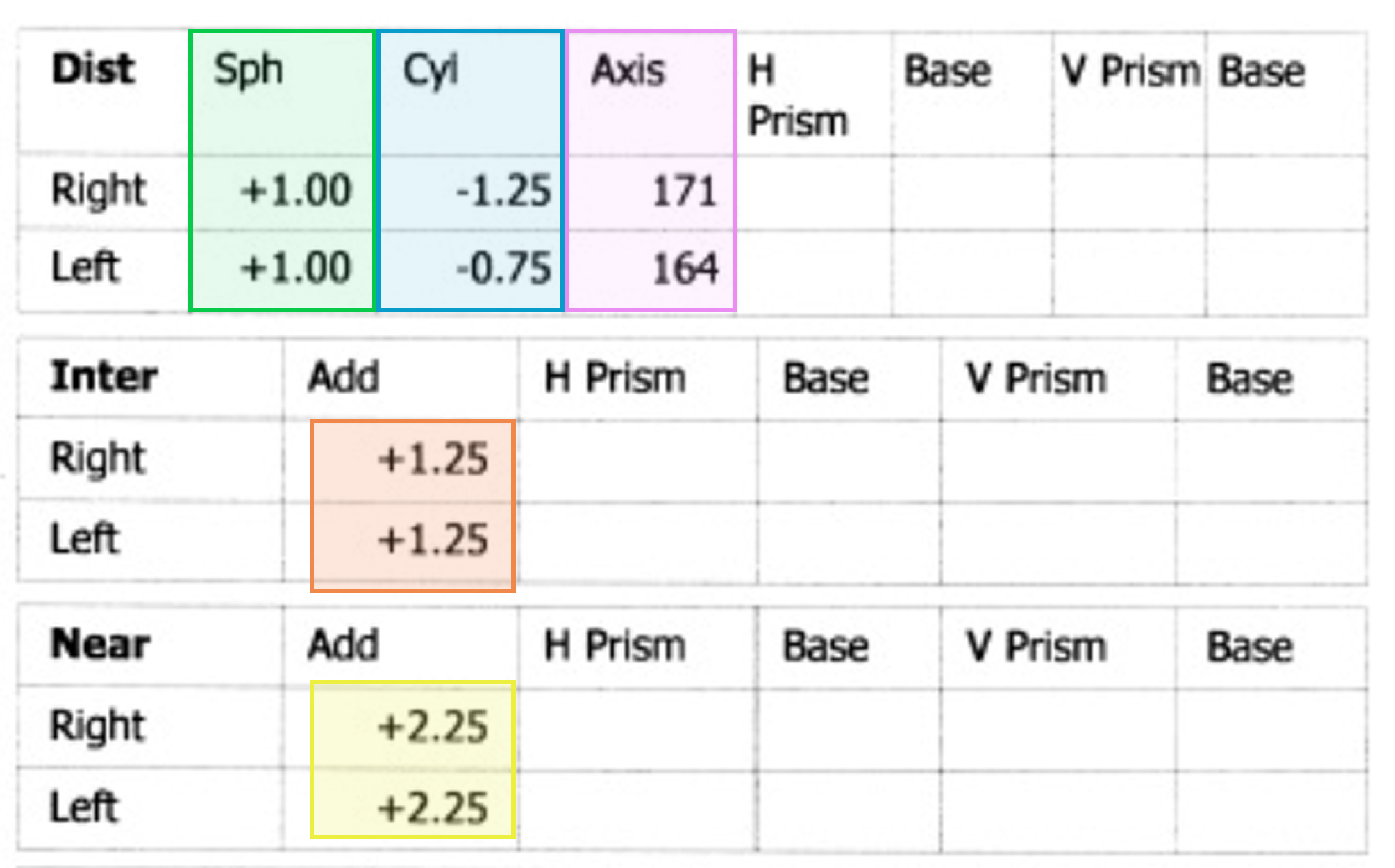
How it should look on our website for Reading glasses:
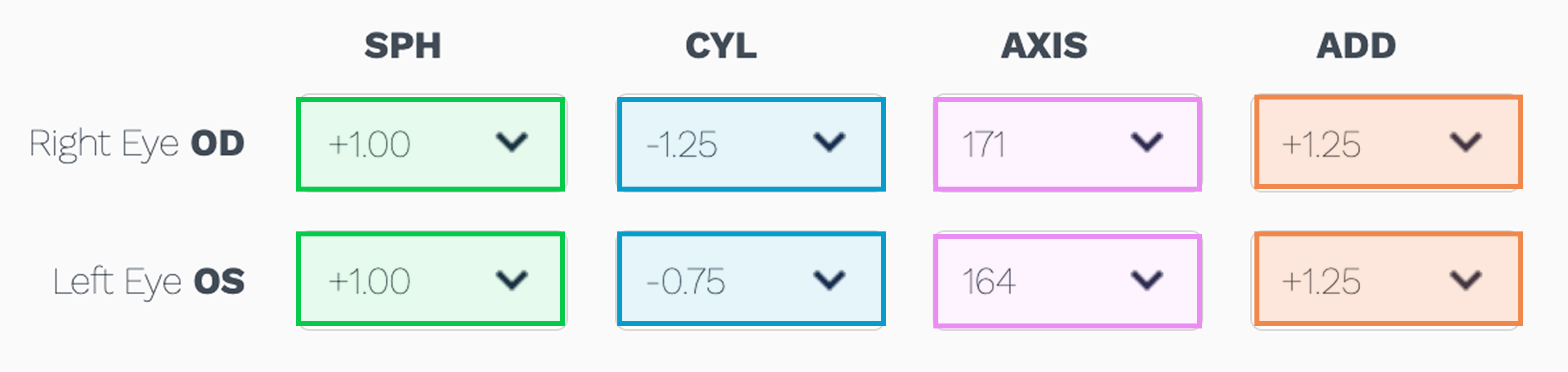
How it should look on our website for Computer glasses:
Boots Prescription
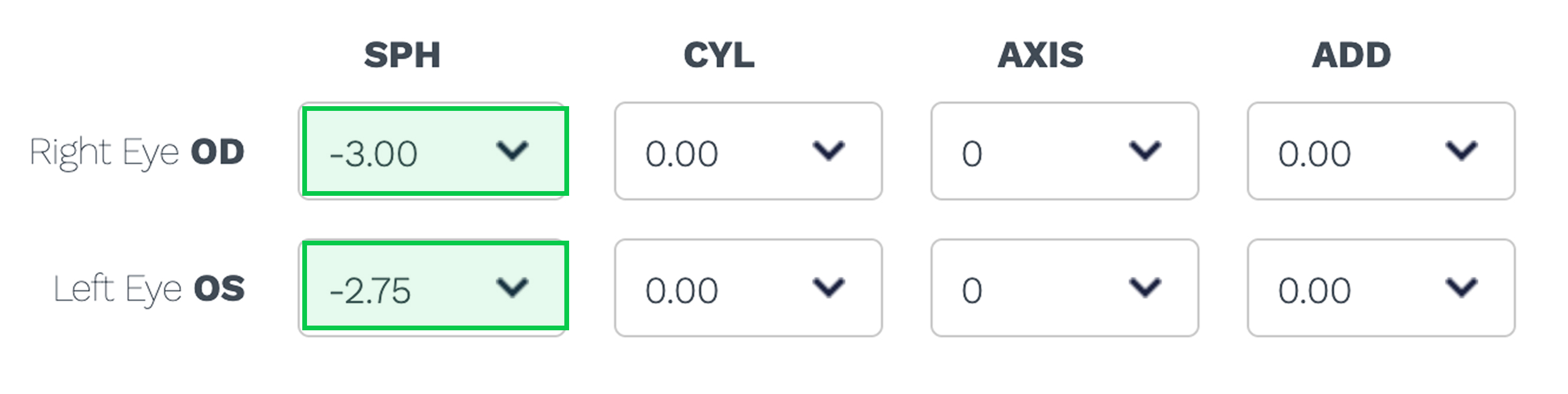
This prescription shows values for the Sphere only. All other fields would be left blank.
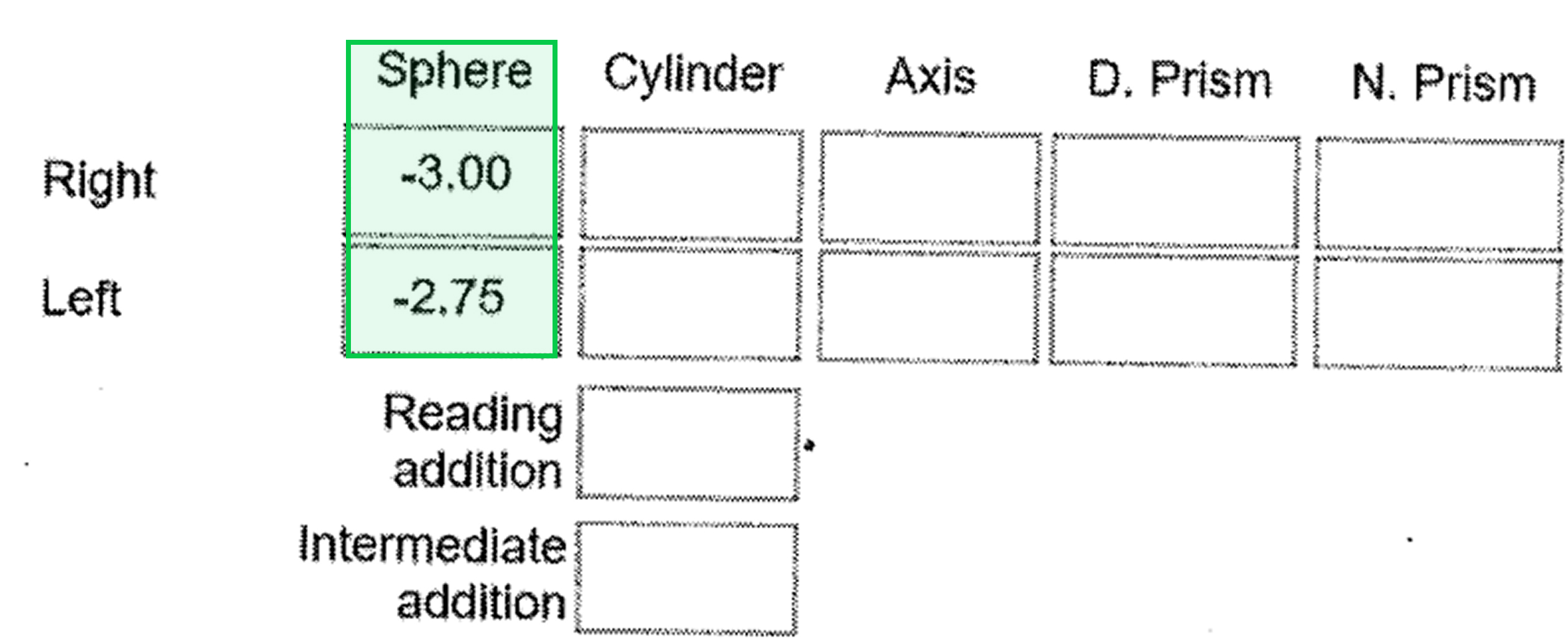
How it should look on our website:
Related Categories
Frequently Asked Questions
What does SPH mean on a glasses prescription?
SPH stands for Sphere. The main lens power needed to correct short-sightedness (myopia) or long-sightedness (hyperopia). The SPH is measured in dioptres (D) in steps of 0.25.
A minus (−) value means short-sighted; a plus (+) value means long-sighted. The higher the number, the stronger the prescription. If SPH shows 0.00, Plano, PL or ∞, there is no spherical correction needed in that eye. However, you may still have a CYL value for astigmatism.
What does CYL mean on a glasses prescription?
CYL stands for Cylinder. It is the lens power needed to correct astigmatism. A condition where the cornea is slightly oval rather than perfectly round, causing blurred or distorted vision.
If the CYL column on your prescription is blank, you do not have astigmatism. If a value is present, it will always be accompanied by an AXIS value. Some opticians write DS (Dioptre Sphere) in the CYL column to confirm there is no astigmatism. If you see DS, leave the CYL field blank when ordering.
What does AXIS mean on a glasses prescription?
AXIS tells the laboratory the angle at which the astigmatism correction (CYL) must be applied to the lens.
The AXIS a number between 1 and 180 degrees and is only ever present when there is a CYL value. A higher AXIS number does not mean a stronger prescription; it simply indicates the direction. Enter the AXIS exactly as written on your prescription without rounding or modifying the number.
What is the ADD value on my prescription?
ADD stands for Addition. This is the extra magnification needed for reading or close-up tasks.
It appears on prescriptions for varifocal, bifocal and reading glasses. The ADD value is almost always the same for both eyes and is always positive, typically between +0.75 and +3.00. If you are ordering varifocal lenses, enter both your distance prescription values and the ADD value. If you are ordering distance-only single vision lenses, the add value is not required.
My prescription does not include a PD, can I still order?
Yes. PD (pupillary distance) is not always included on a glasses prescription. Opticians are not legally required to provide it.
You can measure your PD yourself at home using our PD guide.
If your order is for a reglaze, we can measure the pd from the lenses already in your existing glasses.
My prescription shows a positive CYL, is that a problem?
Not at all. Prescriptions can be written in either minus cylinder or plus cylinder format. Both describe the same eye, just expressed differently.
When entering your prescription online you will notice both plus and minus cylinder values. Double check that you are selecting the correct values. We recommend uploading your prescription and our team will handle the prescritpion for you.
How long is my glasses prescription valid for?
In the UK, a glasses prescription is typically valid for two years for adults. After this time, the prescription is considered expired. A new eye examination is required before you can order prescription glasses online.
Some opticians may issue a shorter validity period for certain conditions. Check the expiry date or review date printed on your prescription.
If your prescription has expired, do not order prescription lenses using it. Your vision may have changed and outdated lenses could cause eyestrain, headaches or difficulty seeing clearly. Contact your optician to book a new eye test.
A glasses prescription cannot be used to order contact lenses, which have different prescription requirements and separate expiry rules.
Can I use my glasses prescription to order contact lenses?
No. Glasses prescriptions and contact lens prescriptions are different.
Contact lenses sit directly on the eye's surface rather than approximately 12mm in front of it. This results in different prescription values. Contact lens prescriptions also include additional information such as base curve, diameter and lens brand. These do not appear on a glasses prescription.
You will need a separate contact lens fitting and prescription from your optician to order contact lenses.
What does Plano or PL mean on a prescription?
Plano (PL) or the infinity symbol (∞) in the SPH column means 0.00. No spherical correction is needed in that eye. You may still have astigmatism (a CYL and AXIS value), an ADD value, or a prism correction, even if the SPH is Plano. Leave the SPH field as 0.00 or select Plano from the dropdown when ordering.
What if I have a prism value on my prescription?
Prism lenses require additional care at the glazing stage. If your prescription includes a prism value, you will need to provide this with your order. There is an additional charge for your lenses to be specially made with your prism correction.
I cannot find my prescription, how do I get a copy?
Contact the optician where you had your last eye test and ask for a copy.
By law, opticians must keep prescription records and must provide you with a copy of your prescription on request. There should be no charge for this.
If the prescription is out of date, over 2 years old. You will need to have a new eye test. Once you have your prescription, you can use it to order glasses online from Direct Sight.