
 Made in our UK lab · Next Day Delivery

High Index Lenses
Thin Lenses for Strong Prescriptions
Published by Direct Sight | Lens Centre
What are high index lenses?
When choosing lenses, an important factor to consider is the lens index. This refers to how thick or thin your lenses are based on your prescription strength. If you have a stronger prescription, you might want to consider high index lenses. Designed to be slimmer and lighter, making them more comfortable and modern-looking.
While thicker lenses can be a more budget-friendly option, they are generally best for mild vision correction.
High-index lenses are made from advanced materials that bend light more efficiently than standard lenses. This allows them to be thinner and lighter while providing the same vision correction.
For most people with mild prescriptions, standard lenses are suitable and look completely normal. But as prescriptions get stronger, typically above ±2.50D for short-sighted or long-sighted glasses, the lens needs to be physically thicker to bend light by the required amount. Without high index material, this can produce the characteristic 'bottle top' and can limit choice of frames.
If you have a stronger prescription, high index lenses transform how your glasses look and feel. They become slimmer, lighter, and more comfortable for all-day wear.
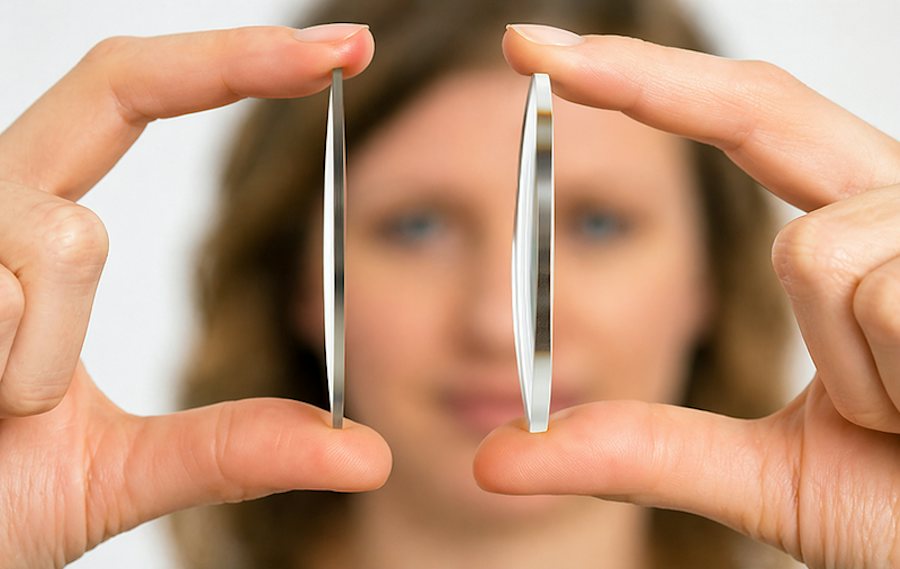
4 factors affect lens thickness
Four factors affect the final thickness of your prescription lenses. The strength of your prescription, your pupillary distance (PD), the size and shape of the frame you choose, and the lens material. The lens material, specifically its refractive index, is the one you have the most control over.
How refractive index works
The refractive index is a number that describes how efficiently a material bends light. The higher the number, the more sharply the material bends light. This means you need less of it to achieve the same level of vision correction.
Standard lenses (1.50 index) need more material to bend light. A 1.67 lens bends light more efficiently meaning it can be made much thinner for the same prescription. While still giving the same visual result.
Which lens index is right for my prescription?
Not every prescription benefits from high index lenses. Choosing a higher index than your prescription requires adds cost without meaningful benefit. Use this guide to find the right level for your specific prescription strength:
| Material/Index | Feature | SPH | CYL | Available from Direct Sight |
|---|---|---|---|---|
| 1.5 (CR-39 Standard Plastic) | Standard thickness | Up to ±2.25 | Up to ±2.00 | ✓ Yes - Uncoated FREE with every order |
| 1.57 Index | 15% thinner than 1.5 Index | ±2.50 to ±5.00 | Up to ±3.00 | ✗ Not currently offered |
| 1.59 (Polycarbonate) | 20% thinner than 1.5 Index | ±4.25 to ±6.75 | ±2.25 to ±3.00 | ✗ Not currently offered |
| 1.6 High Index | 25% thinner than 1.5 Index | ±4.25 to ±6.75 | ±2.25 to ±3.00 | ✓ Yes |
| 1.67 High Index | 33% thinner than 1.5 Index | ±7.00 to ±9.00 | ±3.25 to ±4.00 | ✓ Yes |
| 1.74 High Index | 42% thinner than 1.5 Index | ±9.25 and above | ±4.25 to ±6.00 | ✗ Not currently offered |
Aspheric lenses - why it matters for high index lenses
Most explanations focus on refractive index. But lens designs, spheric or aspheric, is just as important for appearance and performance.
A spherical lens has a consistent curve across its entire surface, like a section of a perfect sphere. This is the traditional lens design and works perfectly well for lower prescriptions.
For stronger prescriptions a spherical lens produces a noticeable bulge or hollow effect. This makes the lens look thick from the side and can cause the 'magnified eye' or 'minified eye' appearance. Wearers with strong prescriptions often find this unflattering.
An aspheric lens has a curve that gradually flattens from the centre to the edge. This means the lens profile is flatter overall. Thinner, lighter, and much better at minimising the magnification effect that can distort how the wearer’s eyes appear. Aspheric lenses also typically provide a wider, clearer field of peripheral vision with less distortion at the edges.
Direct Sight 1.67 lenses are aspheric as standard
All 1.67 index lenses available at Direct Sight are manufactured with aspheric curvature as standard. You do not need to request this separately or pay an upgrade fee. This enhances both visual clarity and the overall appearance of the finished glasses.
Why anti-reflective coating matters more with high index lenses
Anti-reflective (AR) coating is a standard recommendation for any prescription lens. But it becomes particularly important with high index materials. Higher index lens materials have a higher surface reflectivity than standard plastic.
Without AR coating, this surface reflectivity makes high index lenses appear more 'glassy'. This is especially noticeable in bright indoor lighting, when driving at night, and in front of screens.
With a quality anti-reflective coating, the lens becomes nearly invisible in appearance. People see your eyes clearly rather than a mirrored surface, and your own vision through the lens is sharper and less affected by glare.
For high-index lenses, AR coating is not an optional extra, it’s essential for both performance and appearance. At Direct Sight, all high-index lenses (1.6 and 1.67) come as standard with anti-reflective, anti-scratch, and UV400 protective coatings.
Which frames work best with high index lenses?
High index lenses significantly expand your frame options compared to standard lenses. However, there are some practical guidelines that will help your glasses look their best, particularly with stronger prescriptions.
Frame Choice Guide for Strong Prescriptions
| What to choose | What to avoid | |
|---|---|---|
| Short-Sighted (-) | Full-rim acetate frames to hide thick edges. Medium or smaller lenses (under ~50mm). | Oversized frames and rimless/drill-mount styles above −4.00D. |
| Long-Sighted (+) | Full-rim frames. Slightly larger (but not oversized) frames for +4.00D and above. | Very small frames, which can make the centre look thicker. |
| General Advice | Full-rim acetate frames, darker colours, and medium sizes (48 to 52mm) for best balance. | Rimless or semi-rimless styles above ±4.00D. Thin metal frames for stronger prescriptions. |

Direct Sight High Index Prescription Glasses
Customise any glasses frame with high index lenses from £28.
High index lenses explained.
At Direct Sight, we offer high-index lenses that provide superior clarity and comfort for stronger prescriptions. These lenses are thinner and lighter than standard ones, reducing the bulky appearance of high-powered lenses. Available in options like 1.6 and 1.67 refractive indices, they enhance both aesthetics and comfort. Additionally, they are coated with anti-reflective treatments to reduce glare and improve clarity, making them ideal for everyday use, driving, and screen time.
Related Categories
Frequently Asked Questions
What are high index lenses?
High index lenses are prescription lenses made for high prescriptions. They produce significantly lighter and thinner lenses in higher prescriptions.
The higher the refraction index (1.60, 1.67, 1.74), the thinner the resulting lens. High-index lenses are recommended for stronger prescriptions, where standard options would result in heavier, thicker lenses. At Direct Sight, high index lenses are available in 1.60 and 1.67 index options.
Do I need high index lenses for my prescription?
Whether you need high index lenses depends on the strength of your prescription. As a UK guide:
Prescriptions up to ±2.25 standard 1.50 lenses
Prescriptions between ±2.25 to ±6.75 benefit from 1.60 index (approximately 25% thinner)
Prescriptions between ±4.00 to ±9.00 benefit significantly from 1.67 index (approximately 33% thinner)
Prescriptions above ±9.00D benefit from 1.74 index lenses.
High CYL (astigmatism) values can also contribute to lens thickness. Some moderate prescriptions with high astigmatism also benefit from a higher index than the SPH value alone would suggest. If in doubt, contact our team at help@directsight.co.uk.
What is a 1.67 lens and what prescriptions is it suitable for?
A 1.67 index lens is a high index prescription lens with a refractive index of 1.67. The lens can be made around 33% thinner than a standard lens of the same prescription. 1.67 lenses are recommended for prescriptions of ±4.00 and above.
At Direct Sight we provide aspheric high index lenses. They further flattens the lens profile and reduces the visual magnification or minification effect associated with strong prescriptions.
1.67 is Direct Sight's thinnest available lens index and comes with anti scratch, anti reflective and UV400 lens coatings.
What is a 1.74 lens and does Direct Sight offer it?
A 1.74 index lens is the thinnest standard plastic prescription lens available. With a refractive index of 1.74, making it approximately 42 to 50% thinner than standard 1.50 index lenses. It is most beneficial for very strong prescriptions above ±6.00D.
1.67 lenses, while still significantly thinner than standard, may still show visible edge or centre thickness.
Important: Direct Sight does not currently offer 1.74 index lenses. Our thinnest option is 1.67 index. If you need 1.74 lenses, contact us at help@directsight.co.uk or 01494 307 345 and we’ll advise on the best option.
What is the difference between 1.67 and 1.74 lenses?
The main difference is thickness. 1.74 lenses are around 10 to 16% thinner than 1.67 lenses of the same prescription, with the greatest benefit seen above ±7.00D. 1.67 lenses provide most of the thinning for prescriptions between ±4.00 and ±6.00D. The additional reduction from 1.74 less noticeable.
Please note: Direct Sight does not currently offer 1.74 high index lenses. Our maximum index is 1.67.
Are high index lenses available for thin lenses with a strong prescription?
Yes, high index lenses are specifically designed for people with stronger prescriptions who want thin and comfortable glasses.
At Direct Sight, 1.67 high-index lenses are available for single vision (distance and reading) and varifocal options. From around ±4.00D, they make a noticeable difference in both thickness and weight.
Do I need an anti-reflective coating with high index lenses?
Yes. At Direct Sight, anti-reflective coating is included as standard on all high-index lenses (1.6 and 1.67). Higher index materials reflect more light, which can make lenses look more reflective and increase glare. Anti-reflective coating reduces this, improving clarity and making the lenses appear nearly invisible, at no extra cost.
Blue light filtering, photochromic or polarised prescription sunglasses tints can be added to high-index lenses at checkout.
What is an aspheric lens and is it different from a high index lens?
High index refers to the material's ability to bend light efficiently (making the lens thinner). Aspheric refers to the shape of the lens curvature. A gradually flattening curve from centre to edge rather than the consistent curve of a spherical lens.
Aspheric lenses are flatter in profile, lighter in weight. They reduce the magnification or minification of the wearer's eyes, that occurs with strong prescriptions. They also typically provide a wider, clearer field of peripheral vision. All 1.67 lenses at Direct Sight are aspheric as standard.
Can high index lenses correct astigmatism?
Yes. High index lenses at Direct Sight correct astigmatism (CYL values). If your prescription includes CYL and AXIS values, these are incorporated into the lens during glazing.
Simply provide your full prescription when ordering. Note that significant astigmatism (CYL values above ±2.00D) can contribute to lens thickness. Some moderate SPH prescriptions with high CYL values also benefit from upgrading to high index.
Which frames work best with high index lenses for a strong prescription?
For short-sighted (minus) prescriptions, full-rim acetate frames with a lens diameter under 50mm work best. The rim conceals the lens edge and a smaller lens diameter reduces edge thickness.
Avoid rimless and semi-rimless styles for prescriptions above −4.00D.
For long-sighted (plus) prescriptions, full-rim frames again work best.
For all strong prescriptions, darker frame colours draw the eye to the frame rather than the lens. Full-rim frames best conceals the thickness of the lens. Medium-sized frames in the 48 to 52mm lens width range typically give the best result.
How long do high index prescription lenses take to make at Direct Sight?
High-index single vision lenses are typically produced and dispatched within 3 to 7 working days. All Direct Sight orders are made in our UK laboratory in Amersham, Buckinghamshire.
Prescriptions with very high CYL values or other complexity may occasionally require additional production time. For urgent orders, our Next Day Express service is available on eligible frames and single vision prescriptions. Next Day Express rders placed before 3pm Monday to Friday will be made and dispatched the same day. Visit our production timescale guide for full details.
Where can I buy high index glasses online in the UK?
Direct Sight offers frames with high index lenses, UK made at our laboratory in Amersham, Buckinghamshire. We offer high quality 1.60 and 1.67 index lenses. Both lens packages include anti-reflective and scratch-resistant coating as standard.
Prescription frames start from £9, with a 30 day no-quibble return policy, free exchanges, and a 365 day workmanship guarantee. Browse our full range at directsight.co.uk. Contact our team at help@directsight.co.uk or 01494 307 345 for advice on the best lens index for your prescription.
Are high index photochromic lenses availeble?
Direct Sight's own photochromic (light-reactive) lenses Adaptions, are available in 1.6 and 1.67 high index. Adaptions lenses darken in sunlight and return to clear indoors. Combining the convenience of photochromic technology with the thinness and lightness of high index. Ask our team for availability and pricing.