
 Made in our UK lab · Next Day Delivery

Office Lenses Explained
Occupational Varifocal Glasses UK | Office & Computer Glasses
Published by Direct Sight | Lens Centre
Standard varifocal lenses are designed for all-day use across every distance. But they dedicate only a narrow zone to intermediate vision (the distance at which most screens sit). The result can be eye strain, awkward head tilting, and discomfort during sustained close-up work.
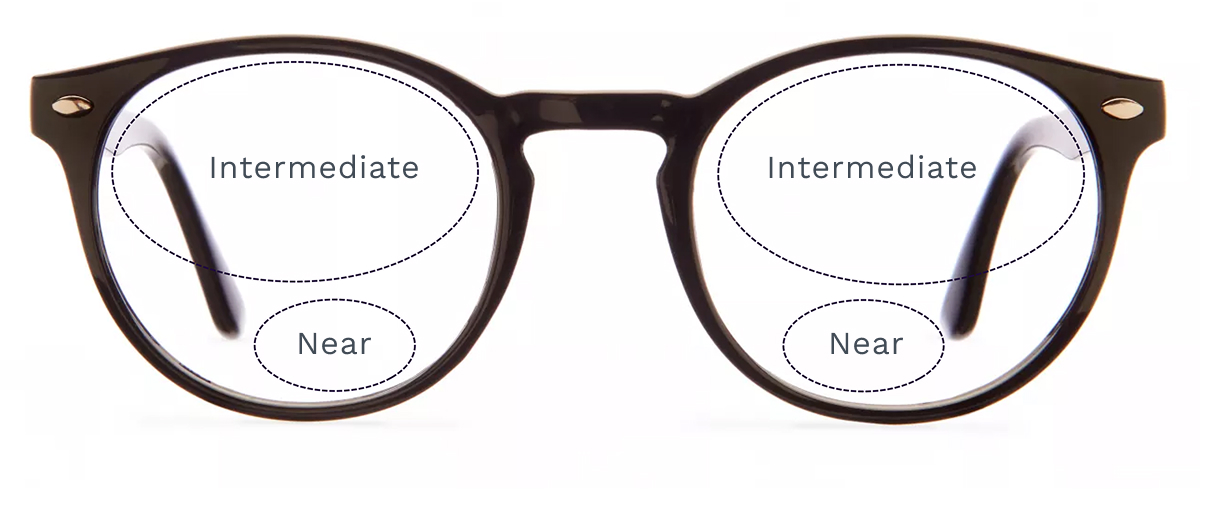
Occupational varifocal glasses, also called office glasses, UK professionals rely on as desk glasses, or computer glasses prescription lenses. They are a specialist type of progressive lens designed to provide near and intermediate vision. Giving you a wide, comfortable field of view for intermediate tasks on digital devices and desk work.
What Are Occupational Lenses?
Often described as intermediate vision glasses or desk glasses UK. Occupational lenses are a specialised type of progressive (varifocal) lens designed to expand the near and intermediate zones.
In a standard varifocal, the lens is divided across three distances, near, intermediate, and far. With the intermediate area limited to a relatively narrow corridor. Occupational lenses take a different approach. The distance zone is removed, allowing far more of the lens to be dedicated to the distances you use at a desk, such as screens and close-up work.
This design trade-off is both intentional and important. Occupational lenses are not suitable for driving or general outdoor use. Instead, they are designed to be worn as a second, task-specific pair alongside your day to day glasses or varifocals. Rather than as a full-time replacement.

Standard Varifocal vs Occupational Lens
| Feature | Standard Varifocal | Occupational Lens |
|---|---|---|
| Distance vision | Full (near, intermediate, far) | Limited - up to 4m maximum |
| Intermediate zone | Narrow corridor | Wide, expanded zone |
| Near/reading zone | Lower portion of lens | Full, wide near zone |
| Best for | All-day general use | Office, desk and screen work |
| Suitable for driving | Yes | No |
| Eye strain at screens | Can cause strain & neck tension | Significantly reduced |
The Three Variants: Reader, Computer and Room
Reader
NEAR RANGE
Best for close reading, writing, and single close-up screen use. Ideal for home-working or focused document and data work.
Computer
MID RANGE
The most versatile option for most office environments, covers your screen, desk documents, and across the table to a colleague.
Room
WIDE RANGE
Covers wider indoor spaces, suited to larger offices, classrooms, workshops, teaching environments and meeting rooms.
Who Are Occupational Lenses For?
Whether you need office glasses UK for daily screen work or occupational glasses UK opticians recommend for specific tasks. These lenses are particularly well suited to:
Varifocal wearers who spend sustained time at a computer, the most common use case in the UK
Office workers, accountants, designers, writers, anyone whose working day centres on a screen and documents
People experiencing digital eye strain, headaches, or neck tension, often caused by tilting the head back to find the intermediate zone in a standard varifocal
Teachers, musicians and laboratory technicians, roles that require sustained near or intermediate focus across a room
Those working from home, a second desk-specific pair is an increasingly common and practical investment
Occupational Lenses vs Single Vision Computer Glasses
For people who don’t require distance correction, single vision lenses set to your computer viewing distance may be sufficient. However, for those with presbyopia who need both reading and intermediate correction, occupational progressive lenses are typically the more effective solution.
You can order occupational lenses online at Direct Sight from £85, with additional lens options available such as blue light filtering and high-index lenses.
Do I Need a Separate Prescription for Occupational Lenses?
Ordering occupational glasses online at Direct Sight is straightforward. Our occupational lenses are UK-made in our own laboratory, for consistent quality and precision.
All you need is your current prescription, including the near (reading) addition. Your optician can advise on which lens variant best suits your typical working distances.
For guidance on reading your prescription and understanding your ADD value, see our prescription guide.
Frame Choice for Occupational Lenses
Occupational lenses need enough vertical lens depth (height) to comfortably fit both the near and intermediate zones. The same rule applies as with varifocal frames. Very shallow or narrow styles can restrict the usable lens area and reduce how smoothly the vision transitions.
For help choosing the right size, see our frame measurements guide. Our team can advise on the best option for your working environment.

Related Categories
Frequently Asked Questions
What are occupational lenses?
Occupational lenses are specifically designed for near and intermediate vision. The distances used most at a desk or computer. Unlike standard varifocals, which divide the lens across distance, intermediate, and near vision.
Occupational lenses expand the intermediate and near zones by reducing or eliminating the distance zone. This gives a wider, more comfortable field of view for screen and desk work.
What is the difference between occupational lenses and varifocals?
Standard varifocals cover all three distances (near, intermediate, far) in a single lens. Making them ideal for all-day general use including driving.
Occupational lenses, also known as computer lenses or prescription glasses for desk work. Sacrifice the far distance zone to expand the near and intermediate zones. This provides a wider, more natural field of view. Reducing eye strain as well as tension in the neck and shoulders caused by awkward head positioning.
As a result, they are much more comfortable for sustained screen use and desk-based tasks. They are designed to be worn as a task-specific second pair. Not as a replacement for everyday varifocals.
Can I drive in occupational lenses?
No. Occupational lenses are not suitable for driving. The distance zone is significantly reduced or eliminated to allow for the wider intermediate and near zones. Meaning clear vision beyond a few metres is not provided. They should be used as a dedicated second pair for desk and screen use only.
Do occupational lenses help with eye strain from screens?
Yes, this is one of their primary benefits. Standard varifocals have a narrow intermediate zone that can cause wearers to tilt or strain their neck and eyes to find the clear screen vision zone. Occupational lenses expand the intermediate zone significantly, allowing the eyes to view a screen naturally without awkward head positioning. Reduced eye strain, fewer headaches, and improved posture are commonly reported benefits.
What prescription do I need for occupational lenses?
Occupational lenses are produced using your existing glasses prescription, including the sphere, cylinder, axis and add value. No separate prescription is required. Your current prescription from your optician contains the information needed. Your optician can advise on the most appropriate focal variant (Desk, Office, or Room) based on your working distances.
Are occupational lenses available online in the UK?
Yes. Direct Sight offers occupational lenses online in the UK, glazed in our own Amersham laboratory. You can order using your existing prescription, just as you would for standard varifocal or single vision lenses. Our team is available on 01494 307 345 or at help@directsight.co.uk if you need guidance on selecting the right office lens type.
What is the difference between Desk, Office, and Room occupational lenses?
These are the three focal range variants. Desk lenses provide clear vision up to around 1.5 to 2m, suited to close reading and single-screen work. Office lenses extend to approximately 2 to 3m, covering a computer, documents, and across a typical desk. Room lenses cover up to around 4m, suitable for larger offices, classrooms, workshops, or meeting rooms.
Can I use occupational lenses if I wear single vision glasses, not varifocals?
Occupational lenses are most beneficial for people with presbyopia, where a reading addition is needed. They provide a smooth progression between near and intermediate distances. If you have a distance prescription without an ADD. Single vision lenses are typically the most suitable and cost-effective choice.