
 Made in our UK lab · Next Day Delivery
How to Measure Your PD (Pupillary Distance)
Your pupillary distance (PD) is one of the most important measurements when ordering glasses online. This guide explains what pupillary distance measurement is. How to measure it accurately at home, and the difference between monocular PD and binocular PD.
Published by Direct Sight | Buying Guide
What is Pupillary Distance (PD)?
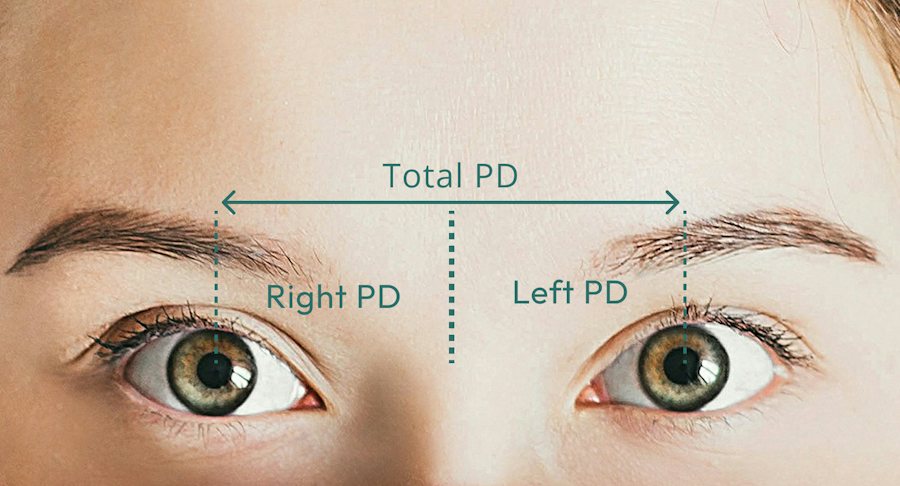
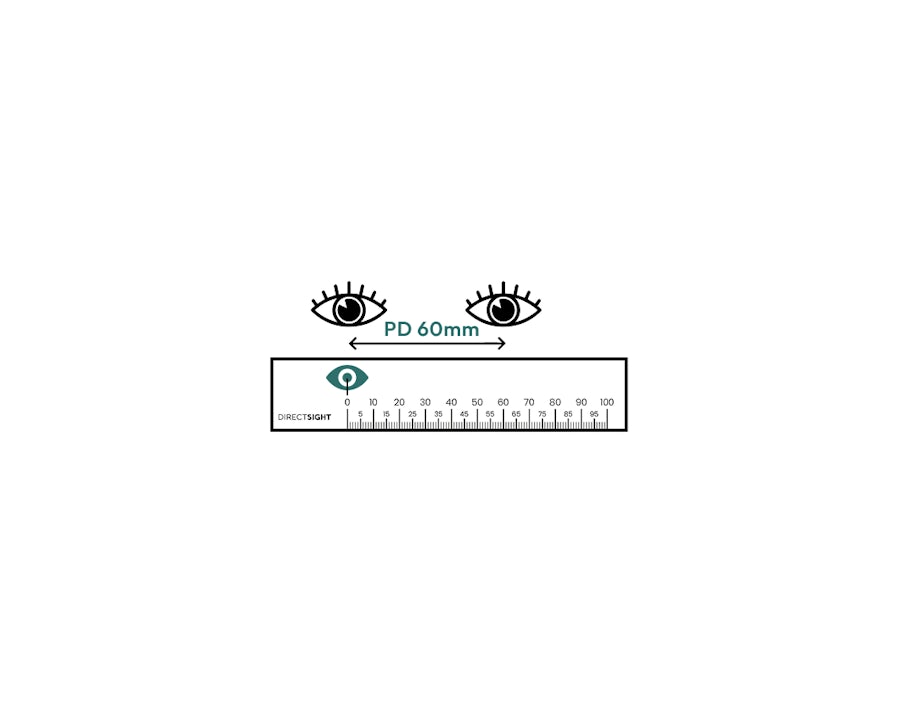
Pupillary distance (PD), measures the distance between the centre of your right pupil and the centre of your left pupil. The value is given in measured in millimeters (mm). It tells our lab technicians exactly where to position the optical centre of each lens. Positioning it precisely with your line of sight.
Why Your PD Matters
- Ensures optical centres align with your pupils
- Prevents eye strain and headaches
- Critical for high-powered prescriptions
- Especially important for varifocal lenses
- Affects how clearly and comfortably you see
Typical PD Ranges
- Adults: 54mm, 74mm (average ~63mm)
- Women: typically 55mm, 68mm
- Men: typically 58mm, 72mm
- Your PD is unique, always measure your own
Binocular PD vs Monocular PD, what's the Difference?
PD can be recorded in two ways:
Binocular PD: The total distance between both pupils, measured as one combined figure.
Monocular PD: Two separate measurements taken from the bridge of the nose to each pupil individually. This is typically given for Varifocals, bifocals and when pupils aren't symmetrical.
Which PD measurement do I need?
For most single-vision glasses, a binocular PD (a single number such as 63mm) is perfectly sufficient. However, if you're ordering varifocal or bifocal lenses, a monocular PD is more precise. When ordering glasses from Direct Sight, you can enter your pd in either format.
Monocular PD values will typically differ by 0 to 3mm. For example, 32 / 31 means 32mm from the nose bridge to your right pupil and 31mm to your left. The two values will equal your binocular PD.
How to Measure Your Pupillary Distance at Home
Measuring your PD at home is straightforward and only takes a couple of minutes. For the most accurate result, ask a friend to help, but the mirror method works well too.
What You'll Need
- A millimetre (mm) ruler or our free printable PD ruler (PDF)
- A mirror (if measuring alone)
- Good, even lighting, natural daylight is ideal
- A pencil to note down your readings
Step 1
Position Yourself and the Ruler
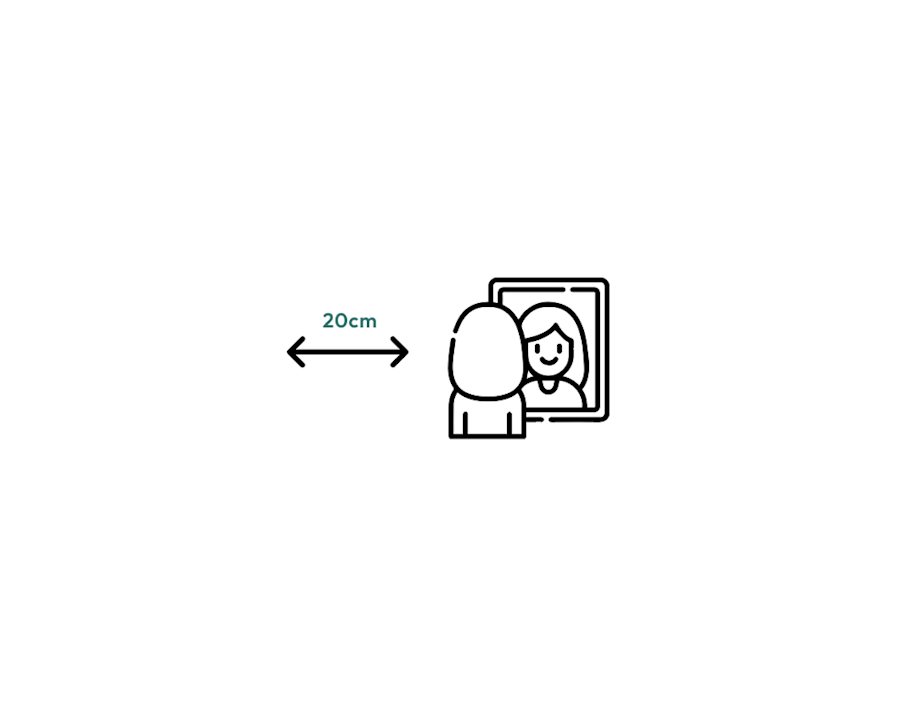
If measuring yourself: Stand approximately 20cm (8 inches) from a mirror in a well-lit room. Place the ruler against your forehead, just above your eyebrows, using the side marked "Using a mirror."
If a friend is helping: Stand roughly 3 metres (10 feet) apart and look straight ahead at a point behind your friend. Ask them to use the side of the ruler marked "Using a friend." This distance helps ensure you're looking straight ahead rather than crossing your eyes slightly to focus on a close object.
Keep the ruler as level and steady as possible throughout the measurement.
Step 2
Align the Ruler and Take the Reading
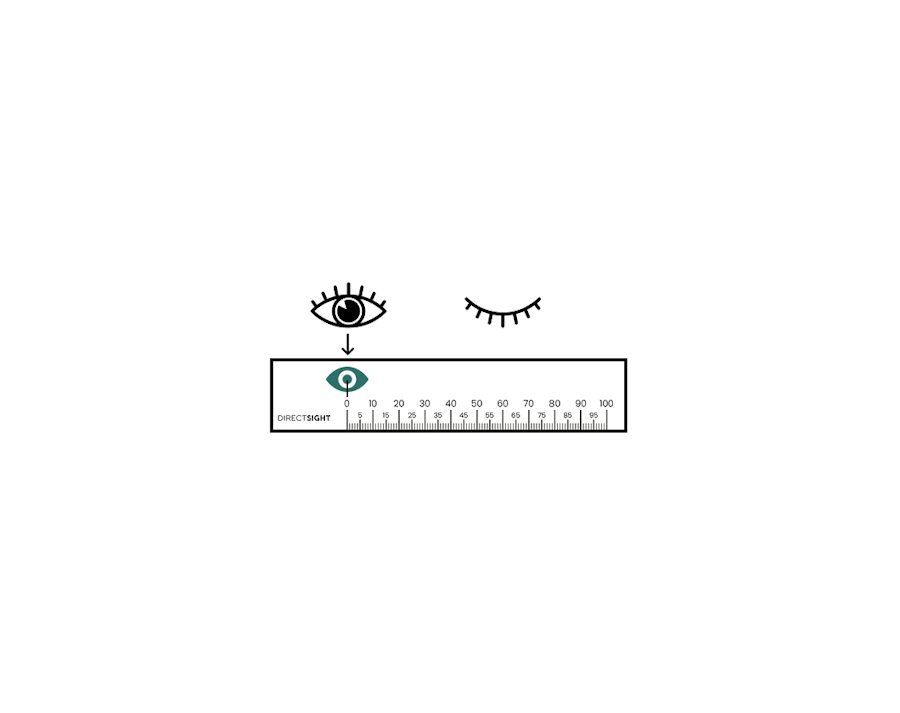
Line up the 0mm mark with the centre of your right pupil. To make sure the ruler is correctly aligned, briefly close your left eye. This lets you focus clearly on your right pupil's position without any shift in gaze.
Once 0 is aligned with your right pupil, look straight ahead (or open your left eye if using a mirror). Note the millimetre reading that lines up with the centre of your left pupil. This number is your binocular PD the distance between the center of one pupil and the other.
For a monocular PD, measure from the centre of the ruler (the nose bridge midpoint) to each pupil separately. Record both readings, for example, 32mm (right) / 31mm (left).
Step 3
Repeat and Take an Average
For the most accurate pd measurement, repeat the measurement at least three times and calculate the average. Small variations between readings are normal. If your readings are all within 1 to 2mm of each other, you can be confident in your measurement.
Write each reading, add them together, and divide by the number of attempts. For example, if you measured 63mm, 62mm, and 63mm, your average pupillary distance is 62.7mm, which you would round to 63mm.
Most PD values are recorded in whole millimetres, though half-millimetre values (e.g. 63.5mm) are also accepted.
Download & Print PD Ruler
Print our downloadable PD Ruler at a scale of 100% on A4 paper. Double check that the measurements are correct by checking the ruler against a standard mm ruler and the credit card length. Then fold along the dotted line.
Other Ways to Find Your PD
- Check Your Existing Prescription - Your PD may already be written on your glasses prescription. Look for a number labelled PD, IPD, or Pupillary Distance. It may appear as a single number (e.g. 63) or two numbers separated by a slash or forward stroke (e.g. 32/31).
- Ask Your Optician - After having your eyes tested ask your optician to confirm your PD value. The PD is not part of the eye exam it is part of the dispense. So if not purchasing glasses from your optician they may not necessarily provide it.
- Use a PD Measuring App - Several smartphone apps are available that use your phone's camera to estimate your PD. These can be a useful backup option, though results can vary depending on lighting and the camera used. For high prescriptions or varifocal lenses, we recommend measuring with a physical ruler for maximum accuracy.
- Measure From Your Existing Glasses - Our trained laboratory technicians can measure the PD from the existing lenses in your old glasses. This is done using a focimeter (also called a lensometer). A reliable backup method and one commonly used for reglaze order.
PD for Varifocal Glasses, why It's Even More Important
If you're ordering varifocal or progressive lenses, getting an accurate PD, and specifically your monocular PD , is especially critical. Varifocal lenses have three distinct vision zones (distance, intermediate, and reading). The precise positioning of these zones depends entirely on where your pupils sit in the frame.
Even a 1 to 2mm error in a varifocal PD can make it significantly harder to find the correct zones when you're moving your eyes. This is one of the main reasons people struggle to adapt to varifocals.
If you're ordering varifocals, we strongly recommend having your PD professionally measured by an eye care professional. If measuring yourself, take extra care to average multiple home measurements.
How to Enter Your PD When Ordering Glasses at Direct Sight
When you reach the prescription entry step during checkout on Direct Sight, you'll see a field for your PD. Here's how to enter it correctly:
Single (binocular) PD: Enter the full number, e.g. 63
Dual (monocular) PD: Enter both values, e.g. 32 (right) and 31 (left)
Half-millimetre values: These are accepted, e.g. 63.5
If you're unsure which to use, a binocular PD is fine for most single-vision prescriptions
If you have any questions about entering your prescription details, our team is available on 01494 307 345 (Monday-Friday, 10am-4pm) or via live chat.

Ready to order your glasses?
Now that you have your PD, browse our full range of prescription glasses from just £9, including lenses.
Related Categories
Frequently Asked Questions
What is pupillary distance (PD)?
Pupillary distance (PD) is the measurement between the centre of your right pupil and the centre of your left pupil. This is usually given as a value in millimeters. It tells our lab technicians exactly where to position the optical centres of your lenses. Ensuring that they align perfectly with your eyes, to provide clear and comfortable vision.
Do I need a PD to order glasses online?
Yes. Your PD is required so that we can make your prescription lenses correctly.
Without it, your lenses may not be positioned accurately in the frame. This can cause blurred vision, headaches, and eye strain. You can measure your own PD at home using a mm ruler and a mirror, see our step-by-step guide above.
What is the difference between monocular and binocular PD?
A binocular PD is a single number representing the total distance between both pupils (e.g. 63mm).
A monocular PD gives two separate measurements from the nose bridge midpoint to each individual pupil (e.g. 32 / 31). Monocular PD is more precise and is particularly important for varifocal or bifocal lenses.
What is a normal or average PD measurement?
The average adult PD falls between 54mm and 74mm. For women it tends to be between 55mm and 68mm, and for men between 58mm and 72mm. Your own PD is unique to you and should always be measured individually rather than assumed from an average.
Can I measure my own PD without going to an optician?
Yes, you can accurately measure your PD at home using a millimetre ruler and a mirror. Our step-by-step guide and free printable PD ruler (above) walk you through the process. For best results, take three measurements and use the average. If you wear a high prescription or are ordering varifocals, consider asking an optician to confirm your measurement.
My PD isn't on my prescription, can I ask my optician for it?
You are legally entitled to a copy of your full prescription. However, your pd is classed as part of the dispense rather than the eyetest. You can ask your optician to provide this however some may refuse.
What if I measure my PD and it seems off, could I be measuring it wrong?
Small variations between attempts are normal. If your readings vary by more than 3 to 4mm, try again using better lighting or ask a friend to help. Common mistakes include holding the ruler at an angle, not looking straight ahead, or misidentifying the centre of the pupil. Repeat the measurement at least three times and average the results for the most reliable reading.
Can I use a PD app on my phone?
Yes, several free apps use your phone's front camera to estimate your PD. These can be useful as a rough guide, but results vary by device and lighting conditions. For single-vision lenses with a moderate prescription, an app measurement is usually acceptable. For high prescriptions or varifocals, we recommend a physical ruler measurement or a professional reading for maximum accuracy.
Is PD the same for glasses and contact lenses?
No. Contact lens prescriptions do not include a PD. This is because contacts sit directly on the eye and naturally centre on the pupil.
PD is only required for spectacle (glasses) prescriptions. Where the lens sits several millimetres in front of the eye inside a frame.
What PD should I use for varifocal glasses?
For varifocal glasses, a monocular PD (two separate readings) is strongly recommended. Varifocal lenses have precise distance, intermediate, and reading zones that must be aligned exactly with your pupils. If in doubt, ask your optician to measure your monocular PD before ordering varifocals online.
My two monocular PD readings are different, is that normal?
Yes, perfectly normal. Most people's faces are slightly asymmetric. The distance from the nose bridge to the right pupil may differ from the left by 1 to 3mm.
For example, a reading of 32 / 31 is very common. As long as the two readings add to a binocular dual PD between the range of 54 to 74mm, your measurement is likely correct.
How accurate does my PD need to be?
For most standard single-vision prescriptions, being within 1 to 2mm is acceptable. For high prescriptions (above ±4.00 dioptre) or varifocal lenses, accuracy to 0.5mm is preferred. This is why we recommend repeating the measurement several times and averaging the results.
What happens if I order glasses with the wrong PD?
If your PD is significantly incorrect, you may experience blurred vision, distortion, double vision, headaches, or eye strain when wearing the glasses. This is particularly noticeable with stronger prescriptions.
If you believe your glasses have been made to an incorrect PD. Contact our customer service team who will be happy arrange a replacement for you with the corrected pd.
Is there a difference between PD for reading glasses and distance glasses?
Your distance PD (the standard measurement taken while looking straight ahead) is used for distance glasses.
For dedicated reading glasses, some opticians provide a slightly smaller near PD. Your eyes naturally converge slightly when looking at close objects. This typically reduces the PD by 3mm (e.g. a distance PD of 63mm might have a near PD of 60mm).
If you're ordering reading-only glasses and only have a distance PD, it's generally still suitable for mild to moderate reading prescriptions.